Forklifts and manual handling create delays when drums, containers, components, or packed goods must visit several fixed process stations. By the end, you will be able to judge whether an overhead trolley route fits your plant, choose between continuous-chain and power-and-free operation, and prepare the measurements a supplier needs for a defensible design.
Key takeaways
- Use powered trolleys when loads must visit fixed stations in sequence.
- Check load weight, fixture design, clearances, curves, washdown and heat exposure.
- Compare overhead capacity and maintenance with forklifts, belt conveyors and floor chains.
- Give manufacturers a route drawing, load data, station sequence and operating conditions.
How a powered overhead trolley route moves loads through a plant
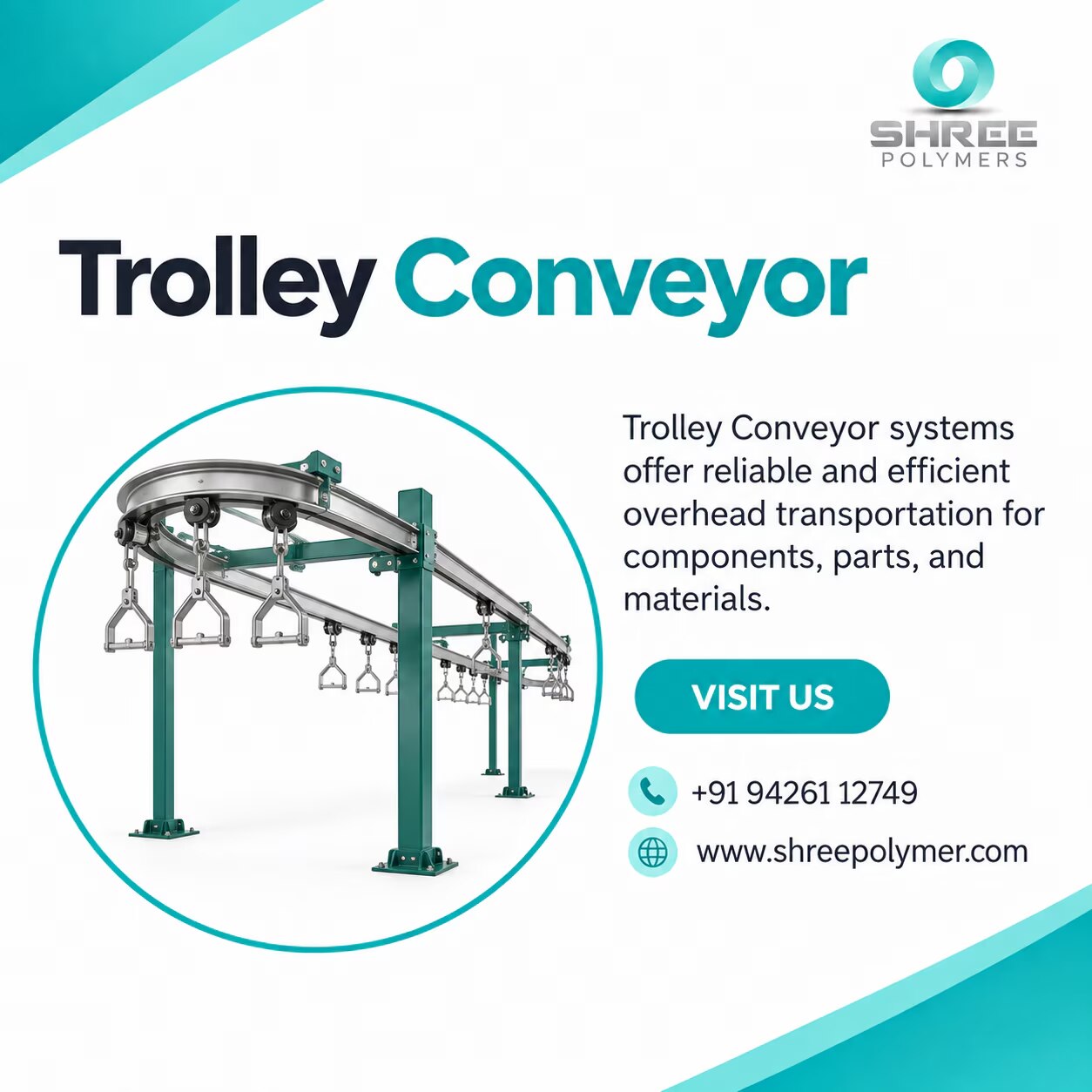
A powered chain circulates along an overhead track, pulling trolleys, hooks, trays, or purpose-built fixtures through fixed process stations. In an Ankleshwar plant, the route can carry drums, containers, components, or packed goods from storage to washing, filling, inspection, curing, weighing, and packing without repeated forklift handling.
Power-and-free industrial trolley conveyors add accumulation control. The powered chain keeps moving while free trolleys stop in a buffer zone, allowing a filling or inspection station to clear without stopping the entire loop. A continuous-chain conveyor moves every carrier together and cannot provide the same independent buffering.
Specify the route in this order:
1. Set the flow: identify loading and unloading points, station sequence, required stops, transfers, reject routing, and whether operators need access below the track.
2. Size movement: with trolley pitch p in metres and line speed v in metres per minute, calculate approximately 60v/p loaded trolleys per hour. Reduce that figure for empty carriers, loading delays, accumulation gaps, and rejected loads.
3. Prove the carrier: keep the load’s centre of gravity below and near the trolley axis, prevent rotation through curves, and retain the load if a container leaks or packaging tears.
4. Verify the structure and controls: check building attachments for static, moving, impact, and vibration loads; then define sensors, PLC handshakes, full-zone signals, identification, stop gates, and power-failure recovery. Conveyor capacity does not certify the roof, columns, or brackets.
Which loads, fixtures and environments suit trolley movement
A trolley conveyor suits loads with a stable centre of gravity, repeatable dimensions and a secure attachment point. Calculate the suspended load as product, container, fixture or load bar, trapped liquid and packaging variation—not product weight alone. That total governs wheels, curves, switches, suspension points and the drive chain.
For material movement conveyors in Ankleshwar, confirm these conditions before selecting the route:
- Use hooks, trays, baskets or purpose-built cradles that keep the centre of gravity below the trolley axis and stop rotation through curves.
- Provide secondary retention for leaking drums, damaged packs or unstable containers.
- Check overhead clearance, support steel and building attachments for static load, moving load, impact and vibration. A conveyor rating does not certify the roof, columns or mezzanine.
- State the hazardous-area classification. Motors, brakes, sensors, junction boxes and controls need protection suited to the classified zone; a painted frame is not protection for a flammable atmosphere.
| Load type | Suitable operating condition | Fixture and environment check |
|---|---|---|
| Chemicals | Sealed containers on a fixed route | Confirm vapour, acid, alkali, salt and washdown exposure; select materials, seals, bearings, fasteners and lubricant accordingly. |
| Intermediates | Consistent batches in trays or bins | Prevent spills and verify cleaning access. |
| Drums | Upright, secured and evenly loaded | Use cradles with positive retention; include liquid weight. |
| Containers | Rigid, dimensionally consistent units | Control sway and orientation at transfers. |
| Packed goods | Cartons or cases with sound packaging | Support weak bases and check compression, moisture and temperature limits. |
How trolley conveyors compare with floor-level alternatives
Choose an overhead trolley when the route must cross occupied floors, connect several process stations, or buffer loads without repeated forklift handling. The trolley conveyor benefits in Ankleshwar outweigh lower installation cost when floor space, load security, and fixed sequencing matter more than a short, straight transfer.
| Option | Strength over trolley | Choose it when |
|---|---|---|
| Belt conveyor | Lower cost for continuous, stable loads | Products travel at floor level on a simple straight route |
| Chain conveyor | Robust handling for pallets or heavy unit loads | Loads need floor support and accumulation is limited |
| Powered roller conveyor | Easy loading, unloading, and zone control | Cases, drums, or pallets have a flat, rigid base |
| Flexible gravity conveyor | Lowest-cost temporary movement | Operators can push light cartons over short distances |
| Tubular disc conveyor | Enclosed transfer with reduced dust exposure | Powder or granules need sealed movement through piping |
An overhead route earns its cost when forklifts, operators, washdown areas, or inspection points consume the floor below. A power-and-free design adds another advantage: free trolleys can queue before filling, weighing, curing, inspection, or packing while the drive chain continues moving.
Do not count nominal capacity alone. Confirm building support for moving and impact loads, clearances around beams and fire systems, and the fixture’s ability to keep drums or containers stable through curves. In a classified flammable area, motors, brakes, sensors, junction boxes, and controls need a protection method suited to that classification.
If automation cannot exchange stop, full, identification, reject, and power-recovery signals, the trolley’s routing advantage can disappear.
How to test an overhead route against the existing plant
Approve a trolley conveyor system in Ankleshwar only after a route survey proves that the building, controls and daily operation can support it. Trace the proposed line over process, storage, inspection and packing areas, then mark every obstruction, access point and emergency route.
1. Verify the structure. Obtain roof, mezzanine and column drawings, then check attachment points for static load, moving load, impact and vibration. Confirm curve clearances, sprinkler coverage, fire exits, maintenance access and headroom; the conveyor’s rated capacity does not certify the building or brackets.
2. Verify safety. Record the plant’s fire and hazardous-area classification. Select approved protection for motors, brakes, sensors, junction boxes and controls where flammable atmospheres exist. Check guarding, load retention, emergency stops, stop gates, fall-object protection and safe access for cleaning and inspection.
3. Verify automation. Put sensor locations, barcode or RFID identification, PLC handshakes, accumulation-full signals and reject routing on the layout. Test the response to a power failure, lost communication, blocked sensor and jam; recovery must not restart a trapped load or create an uncontrolled release.
4. Verify operation. Run the heaviest and largest fixture through every straight, curve, incline, station and accumulation zone. Measure clearance, cycle time, noise, washdown exposure, temperature and operator access, then confirm that forklifts can still pass without crossing the moving route.
Record these tests in the approval file, including photographs, structural calculations, control cause-and-effect logic and failure-test results. Reject the route if any load, stop gate, fire separation or maintenance task depends on guesswork.
What to put in a trolley conveyor manufacturer’s design brief
A comparable quotation starts with a shared design brief, not a catalogue load rating. Give every trolley conveyor manufacturer the product weight including container, fixture, load bar, trapped liquid and packaging variation; maximum dimensions; centre of gravity; hanging points; surface condition; and leak or rotation risks.
State the required trolley pitch, speed range, duty cycle, operating hours, route length, curve radii, gradients, loading points, accumulation gaps and reject handling.
Use this calculation for the theoretical rate: 60v/p trolleys per hour, where v is line speed in metres per minute and p is trolley pitch in metres. Then deduct empty carriers, loading delays and accumulation losses.
- Specify structural assumptions: building steel or independent supports, allowable loads, support spacing, rail deflection limit, thermal movement, seismic requirements and expected noise level.
- State the environment: temperature, humidity, washdown chemicals, dust, corrosion exposure and hazardous-area classification. Identify the required protection method for motors, brakes, sensors, junction boxes and controls; a painted frame does not make ordinary electrical equipment safe in a flammable area.
- Define controls: start-stop logic, variable speed, zone accumulation, interlocks, emergency stops, overload detection, position sensors, recipe changes and fault reporting.
- Require access for inspection, chain-tension adjustment and lubrication, plus wheel and bearing wear limits, critical spares and a preventive-maintenance schedule.
| Acceptance item | Specify in the quotation | Test or document required |
|---|---|---|
| Capacity | Rated load per trolley and drive margin | Loaded trial run |
| Route | Rail joints, switches, curves and clearances | Full-route inspection |
| Performance | Rate, speed, noise and accumulation | Recorded acceptance test |
| Maintenance | Lubrication points and adjustment range | Manual and spare-parts list |
Shree Polymers can use this brief to distinguish a genuinely engineered proposal from a nominal capacity copied from a catalogue.
Related product
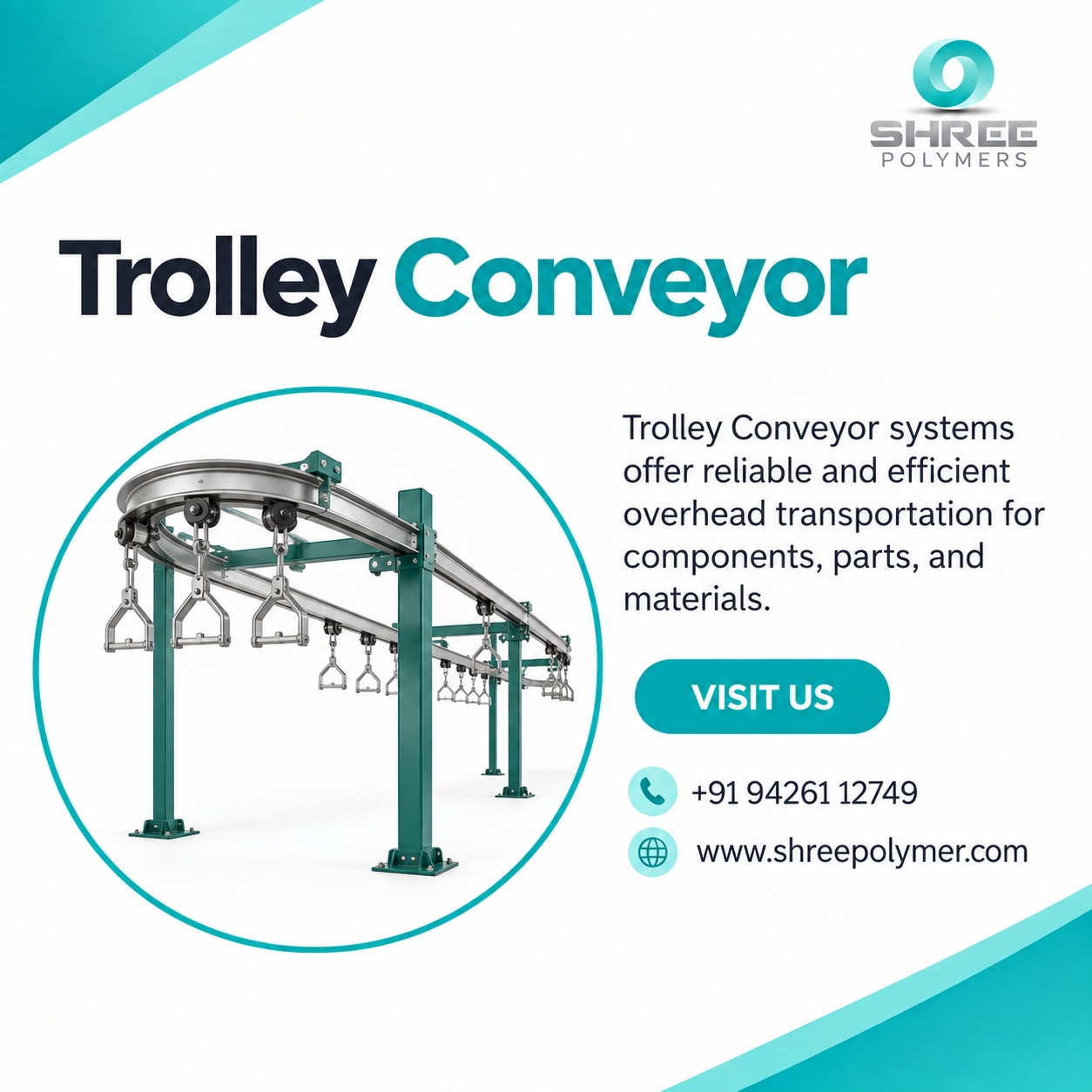 | Conveyors and Automation Trolley Conveyor POLYSTEEL trolley conveyors are included in the conveyor systems range for industrial material movement. |
Frequently asked questions
How does a powered overhead trolley route move loads?
A motor-driven chain circulates around an overhead track and pulls trolleys carrying hooks, trays, drums or custom fixtures through fixed stations.
Which loads and environments suit trolley conveyors?
Trolley movement suits repeatable routes for drums, containers, components and packed goods, provided the fixtures match the load and the route suits washing, heat, dust or chemical exposure.
How do trolley conveyors compare with floor-level alternatives?
Overhead trolleys preserve floor space and reduce forklift crossings, while floor conveyors can simplify loading, access and maintenance for low-level transfers.
How can you test an overhead trolley route before installation?
Map the route, measure clearances, confirm load and fixture weights, check station cycle times, and compare required throughput with the existing plant layout.
What belongs in a trolley conveyor manufacturer's design brief?
Provide load dimensions and weights, fixture details, route drawings, station sequence, speed, throughput, environmental conditions, available headroom and safety requirements.
Keywords