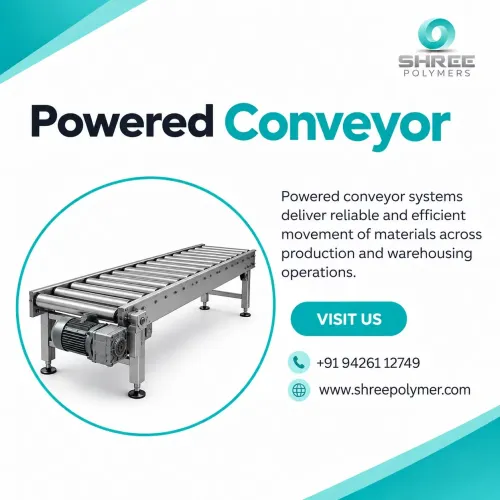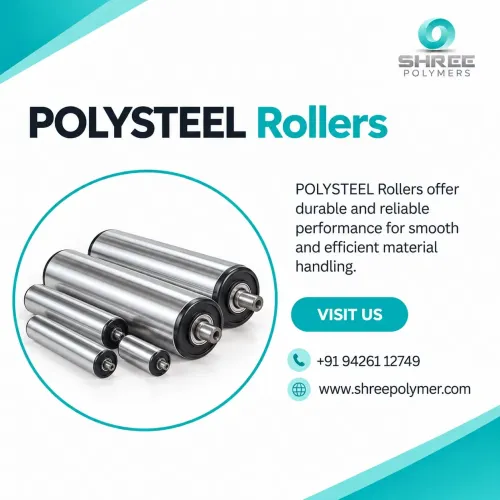
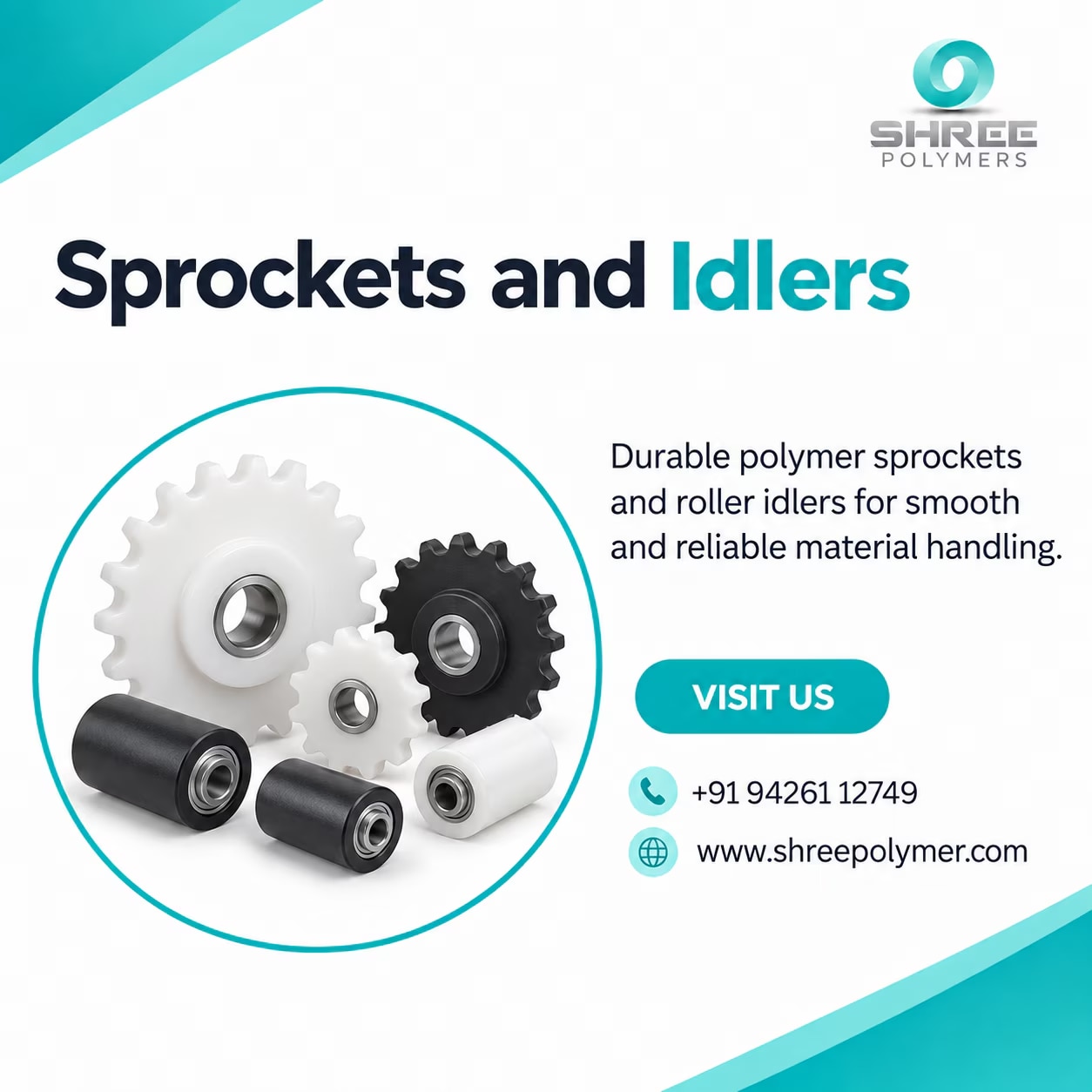
A sprocket and an idler perform different mechanical jobs: one transfers positive drive through chain or modular-belt teeth, while the other supports, guides, tensions, or returns a conveying surface. By the end, you will be able to match each component to the conveyor architecture, specify its dimensions and materials, and identify the installation errors that cause noise, tracking problems, and premature wear.
Key takeaways
- Match sprocket teeth to chain pitch, roller diameter, and inside width.
- Place idlers to support load zones without forcing belt tracking errors.
- Specify stainless steel, polymer, or coated parts for the actual environment.
- Check shaft alignment, bearing play, tooth engagement, and belt tension before startup.
Where sprockets and idlers belong in a conveyor system
A sprocket transmits drive; an idler supports or guides. A sprocket’s teeth engage the pitch, roller, and inside width of a chain or modular belt, transferring shaft torque without relying on friction. An idler rotates freely on bearings, carrying the belt, maintaining its path, or absorbing loading impact.
It is not a substitute for a drive pulley.
| Component | Practical function | Typical applications |
|---|---|---|
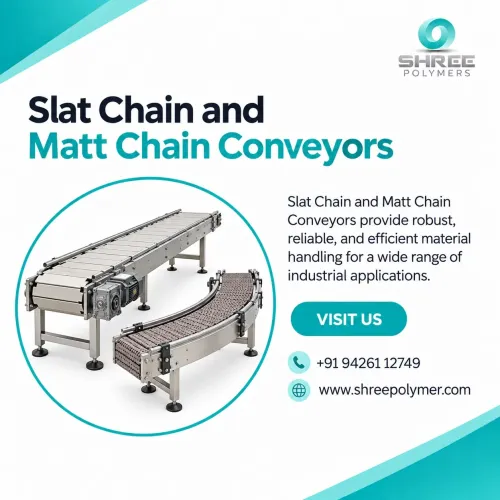
| Sprocket | Positive engagement with chain or modular belt | Chain conveyors, slat-chain conveyors, matt-top conveyors, packaging lines, and accumulation conveyors |
| Idler | Supports, returns, guides, or cushions a belt without driving it | Bulk-material belt conveyors, incline conveyors, carrying runs, return runs, transitions, and loading zones |
For sprocket and idler applications in Ankleshwar, identify the conveyor architecture before specifying a part. A sprocket belongs at a chain or modular-belt drive and must match the chain series, pitch, tooth profile, bore, keyway, and shaft. Industrial conveyor sprockets in Ankleshwar are not generic rollers.
Idlers belong between the drive and return points of belt conveyors. Choose their diameter, bearing arrangement, shaft, trough angle, and spacing for belt width, speed, tension, bulk density, and lump size. Reduce spacing near loading zones, transitions, and heavily loaded sections, or unsupported belt sag can cause spillage and belt damage.
How to select a sprocket for chain and modular-belt drives
A sprocket can match the chain pitch and still fail to transmit the load smoothly. Confirm the roller diameter, inside width, tooth form, attachment geometry and chain series; for modular belts, match the manufacturer’s belt series and drive-bar profile, not just the nominal pitch.
Check these drive and shaft details before selecting the part:
- Choose a tooth count that limits articulation and polygonal action. Small sprockets increase joint movement and wear; more teeth improve smoothness but raise shaft torque, centre distance and cost.
- Calculate torque from the conveyor load and speed, then check the sprocket, chain, shaft, key, keyway and hub against that torque. Specify bore tolerance, shaft diameter and keyway dimensions.
- Confirm face width, chain-row spacing, belt width, centre distance and attachment clearance. A narrow face or incorrect spacing can cause side loading and tooth wear.
- Check washdown water, chemicals, abrasive dust, product temperature, lubrication access and guarding. Carbon steel costs less; stainless or plated steel resists corrosion, while engineered polymer reduces noise but has lower load and temperature limits.
- Verify that replacement chain and sprockets remain interchangeable. Ask for engagement validation, load rating, speed limit and inspection records rather than accepting a dimensional drawing alone.
For industrial conveyor sprockets in Ankleshwar, compare the operating combination, not merely the catalogue part:
| Drive | Match exactly | Failure if mismatched |
|---|---|---|
| Chain conveyor | Pitch, roller diameter, width and tooth profile | Binding, jumping or rapid tooth wear |
| Modular belt | Belt series, drive-bar geometry and face width | Skipping or belt damage |
| Shaft assembly | Bore, keyway, hub and torque capacity | Fretting, slip or shaft failure |
How idler design and placement affect belt performance
Choose idlers by belt width, speed, trough angle, belt tension, bulk density, lump size, loading impact and environment—not by roller diameter alone. Conveyor idlers for manufacturing need smooth, low-noise support around packaging and transfer points; bulk-material conveyors need stronger frames and bearings for heavier loads.
| Idler type | Choose it for | Position and design check |
|---|---|---|
| Carrying | Loaded belt support | Use three-roll troughing sets at the specified angle; reduce spacing through loading zones and heavily loaded spans. |
| Return | Empty belt support | Use single rolls; choose disc-equipped rolls for sticky carryback, but provide cleaning space to prevent wet or fibrous material packing between discs. |
| Impact | Concentrated drop loads | Place directly beneath the loading chute. Rubber rings or an impact bed absorb shock, but control drop height, chute trajectory and segregation. |
| Transition | Belt shaping near pulleys | Install between the final troughing set and pulley, with progressively changing trough angles; inadequate support folds or stresses belt edges. |
| Self-aligning | Corrective tracking support | Place at selected carrying or return points, not throughout the conveyor. It cannot fix skewed pulleys, unequal tension, poor loading or a damaged belt. |
Reduce spacing near belt transitions and high-tension sections as well as loading zones. A uniform layout can leave the belt sagging, deforming or spilling material where support matters most. Match each idler’s shaft, bearing and frame width to the conveyor, and account for washdown, dust, heat and corrosion.
Choosing materials for wear, washdown, heat, and product contact
Abrasive solids usually justify hardened or alloy-steel sprockets and idler shells; polymer parts wear rapidly under sharp, heavy particles. Match the material to the failure mode, not just the product name.
| Material | Best fit | Limits and checks |
|---|---|---|
| Carbon steel | Dry bulk conveyors and cost-sensitive drives | Protect against rust; abrasive dust accelerates tooth and shell wear |
| Hardened or alloy steel | Stone, sand, glass, and heavy abrasive solids | Higher wear resistance; confirm hardness, load, and replacement availability |
| Stainless steel, usually 304 or 316 | Washdown, corrosion, food-contact zones, and chemical exposure | 316 handles chlorides better; verify chemical compatibility and food-contact compliance |
| Engineered polymer such as UHMW-PE or acetal | Quiet packaging, accumulation, and light-duty wet lines | Lower noise and corrosion, but limited by load, abrasion, chemicals, and temperature |
| Plated or coated steel | Moderate corrosion where the coating remains intact | Scratches expose steel; do not treat plating as a substitute for stainless in aggressive washdown |
| High-temperature steel | Ovens, hot parts, and elevated-temperature conveyors | Specify operating and peak temperature; seals, grease, and polymer components may fail first |
For idlers, specify sealed bearings, end covers, and washdown-compatible seals. Wet or fibrous carryback can pack return-disc idlers, so provide spacing and cleaning access.
The installation checks that prevent tracking, vibration, and tooth wear
A correctly specified component still fails when installation geometry or operating load is wrong. Verify the installation before running product.
- Set sprocket faces in one plane and shafts parallel; use a straightedge across faces and check that the chain enters the teeth without lateral forcing. Check key, hub, and shaft runout.
- Confirm chain, belt, and frame clearances through full rotation, including guards, transfers, return paths, and thermal expansion. Set each idler shaft square to the belt centreline and at matching elevation.
- Measure bearing and shaft loads at startup and peak load, not only during empty running. Prevent overhung sprocket torque, belt edge loading, and impact loads from exceeding the selected ratings.
- Run slowly and inspect tooth contact, chain side-plate marks, belt tracking, idler noise, and hot bearings. Uneven marks identify misalignment; repeating lift or drop points indicate polygonal action or poor support.
- Lubricate only where the chain or bearing design permits, keep washdown chemicals out of seals, and record tooth, roll, bearing, and keyway condition at planned intervals. Replace worn sprockets with the matching chain pitch and tooth form; a new chain on hooked teeth accelerates wear.
What to include in a supplier specification before ordering
Give a sprocket idler supplier in Gujarat a signed conveyor data sheet, not only a sketch. Whether you approach Shree Polymers or another supplier, require confirmation that the complete chain, shaft, bearing and loading combination has been checked.
- Record chain or modular-belt designation, pitch, tooth count, belt width, sprocket face width, roll diameter, shaft diameter, bore tolerance, keyway, hub style and bearing arrangement.
- State speed, allowable working load, start-stop frequency, reversing, indexing, accumulation, shock loading, incline angle, product weight and expected peak tension.
- Specify material grade, coating, washdown chemicals, abrasive dust, product-contact status, operating temperature, lubrication method, seal type and guard clearances.
- Request a dimensioned drawing, material certificate, inspection report, load and speed limits, and written confirmation of tooth engagement, belt compatibility, shaft and bearing loading, parallel-shaft alignment and installation tolerances.
| Replacement requirement | What to require | Why it matters |
|---|---|---|
| Part identification | Permanent part number and revision on the drawing and component | Prevents ordering a visually similar mismatch |
| Interchangeability | Bore, keyway, width, bearing and mounting dimensions | Allows a direct replacement without frame modification |
| Spares | Bearing, seal, sprocket and idler availability, minimum order and lead time | Prevents extended downtime |
A supplier that cannot document these points has supplied a component, not a validated replacement.
Related product
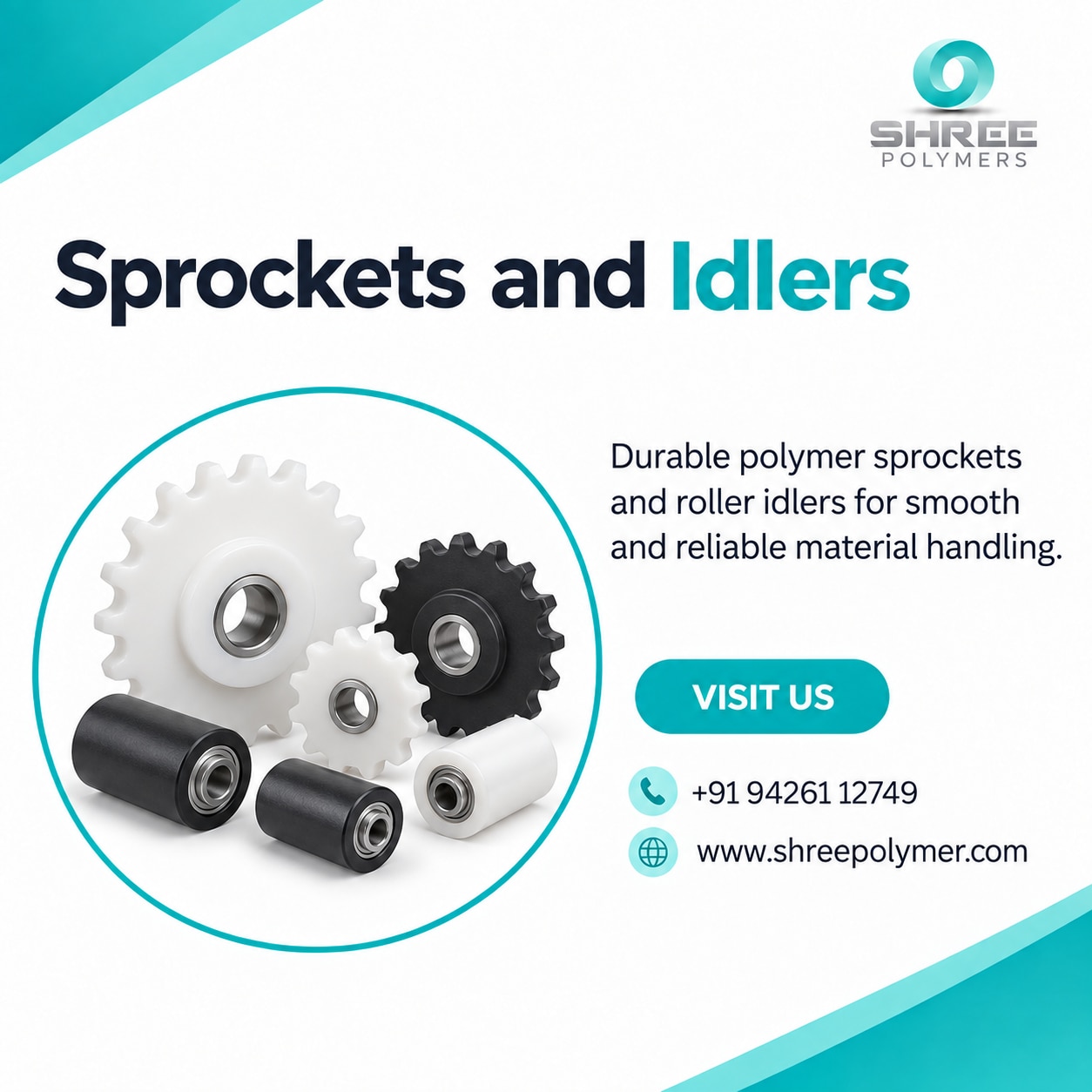 | Guides and Change Parts Sprockets and Idlers POLYSTEEL sprockets and idlers are included in the guide profiles and change-parts range for customised conveyor and packaging applications. |
Frequently asked questions
Where do sprockets and idlers belong in a conveyor system?
Sprockets belong on powered shafts where their teeth engage a chain or modular belt. Idlers support, guide, or cushion the belt along return and carrying runs.
How do you select a sprocket for a chain or modular-belt drive?
Match the sprocket to the chain or belt pitch, roller diameter, inside width, tooth profile, shaft bore, keyway, and required torque.
How does idler design and placement affect belt performance?
Idler diameter, bearing condition, spacing, and alignment affect belt support, tracking, vibration, loading impact, and resistance to belt sag.
Which materials suit sprockets and idlers?
Choose stainless steel for corrosion and washdown, engineering polymers for low noise and product contact, and suitable metals or coatings for heat and abrasive service.
What installation checks prevent tracking, vibration, and tooth wear?
Verify shaft parallelism, sprocket alignment, bearing seating, belt tension, idler level, tooth engagement, and free rotation before commissioning.
Keywords