Bottle, can, carton and pouch lines often lose time at transfers, accumulation zones and machine in-feeds rather than at the conveyor’s rated load limit. You will be able to distinguish slat and matt chains, match each configuration to your products and cleaning regime, and prepare a specification that can be tested under real production conditions.
Key takeaways
- Use matt chains for flexible routing, accumulation and stable container handling.
- Choose slat chains when rigidity, load support or open drainage matters.
- Compare transfer gaps, cleaning access, noise and maintenance—not belt type alone.
- Prove improvement with measured stops, transfers, speed, noise and product damage.
How slat-chain and matt-chain conveyors differ at the product surface
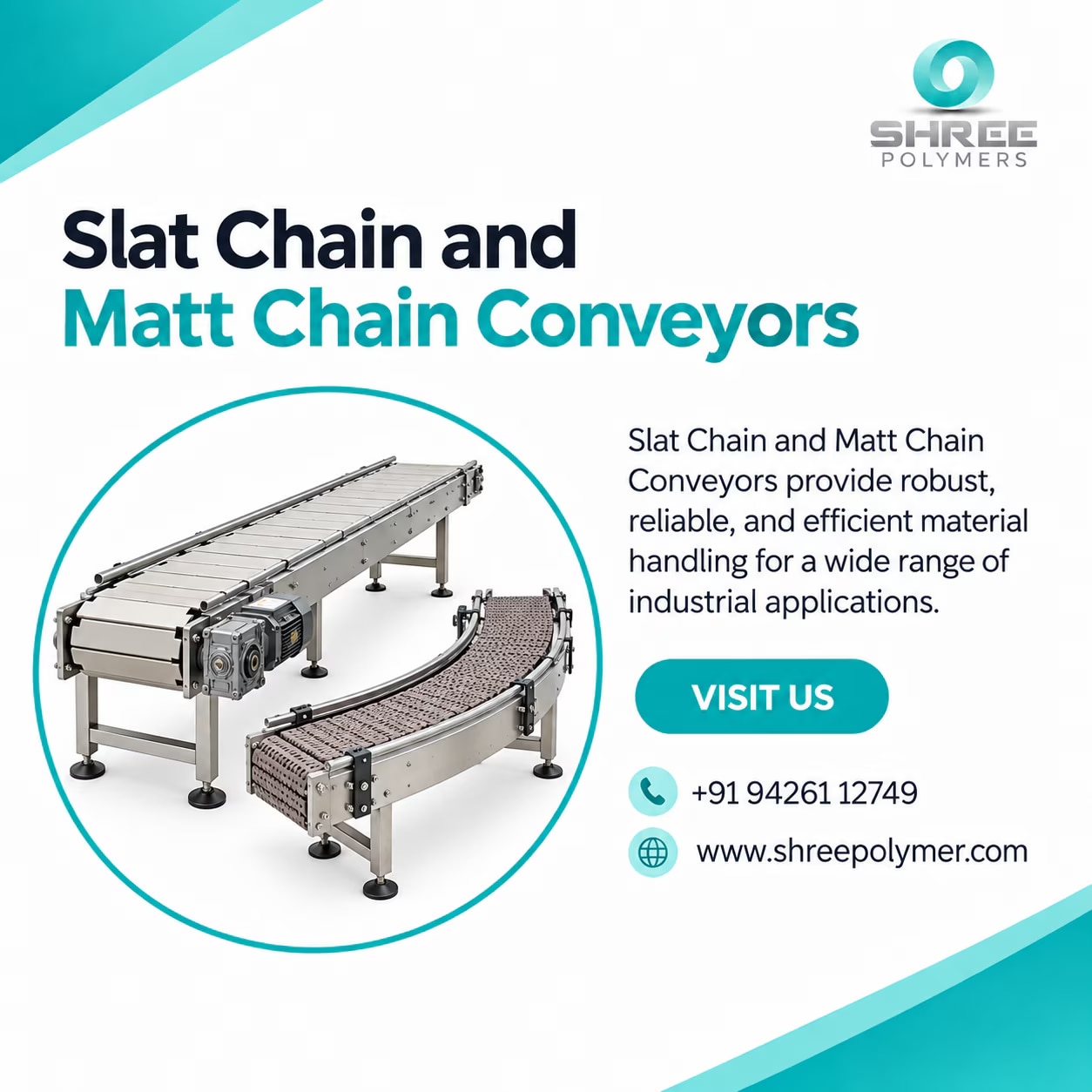
A slat chain conveyor carries products on linked metal or plastic slats, leaving a relatively rigid surface with defined hinge gaps and pitch. A matt chain conveyor uses interlocking modular plastic links driven by sprockets, creating a more continuous product-contact surface. That difference affects transfers, accumulation and product stability.
| Construction | Product surface and movement | Suitable products |
|---|---|---|
| Slat chain | Rigid slats provide firm support and predictable transfers; steel handles heat, sharp containers and aggressive cleaning, while plastic reduces noise and scuffing | Bottles, jars, cans, cartons, trays and cases that need controlled spacing or stable support |
| Matt chain | Modular links form straight-running, side-flexing, grip-top or low-back-pressure surfaces; the hinge design and sprocket pockets determine flexibility and cleanability | Pouches, packaged food, bottles, cartons and products requiring curves, gentle accumulation or more continuous support |
Choose a slat chain conveyor in Ankleshwar when container rigidity, repeatable indexing or mechanical strength matters more than a nearly seamless surface. Check the slat pitch, hinge construction and transfer nose; a wider gap can catch small bases or unstable packs.
Choose a matt chain conveyor in Ankleshwar for layout flexibility, side-flexing routes or controlled back-pressure. Modular plastic does not automatically make the conveyor hygienic: hinge rods, sprocket pockets, frame joints and return supports need inspection and washdown access. Specify the detergent, concentration, temperature and exposure time before approving the chain material.
Where these conveyors improve packaging-line movement
They improve packaging-line movement by supporting rigid containers continuously, maintaining repeatable spacing, and reducing the jolts that cause tipping, scuffing or missed machine timing. The chain does not create this result alone; transfer geometry, guide-rail adjustment and controlled accumulation decide whether the line remains stable.
- At filling, the conveyor holds bottles, jars or cans upright while the filler meters product into a consistent presentation zone.
- At capping, steady pitch keeps each container aligned with the capper starwheel, chuck or spindle.
- At labelling and coding, controlled support prevents rotation, gaps or side contact from producing misplaced labels and unreadable codes.
- At inspection, smooth travel gives cameras and sensors a repeatable view instead of exposing them to vibration or wandering products.
- At packing, the chain feeds cartons, trays or cases into collators and case packers without sudden bunching at the infeed.
- At palletising, it delivers closed cases at a predictable rate, allowing the palletiser to receive each case without catching or uneven stacking.
For packaging conveyor systems, give special attention to the transfer between machines. A short dead plate or small nose-over reduces the gap where a bottle base can catch, while properly set rails stop a carton from yawing into the next conveyor.
Match chain speed to product pitch and line rate rather than increasing speed to recover every stoppage. Metered accumulation protects fragile packs; excessive back pressure creates scuffs, jams and unstable releases.
How chain conveyors compare with belts and rollers
Choose a slat or matt chain when the product needs controlled support through transfers, turns or accumulation, not merely a surface to travel on. A slat chain suits rigid bottles, jars, cans and cartons that benefit from a firm, linked surface.
A matt chain, built from interlocking plastic modules, offers a more continuous surface and can be specified as straight-running, side-flexing, grip-top or low-back-pressure.
| Option | Choose it when | Main limitation |
|---|---|---|
| Slat chain | You need rigid support, repeatable transfers or resistance to hot products and aggressive cleaning | Hinges and pitch affect transfer smoothness; flat versions create contact pressure during accumulation |
| Matt chain | You need a quieter, continuous plastic surface for bottles, trays, pouches or packaged food, including curves | Confirm temperature, detergent, solvent, ultraviolet and load limits for the exact plastic |
| Belt conveyor | The product is stable on a continuous, low-friction surface and the route is mainly straight | Belt tracking, sanitation and splicing become failure points; transfers can destabilise small packs |
| Roller conveyor | Cartons, cases or rigid loads can bridge rollers and need accumulation or gravity movement | Poor choice for flexible packs, small containers or unstable bases |
| Conventional industrial chain conveyors | You are moving heavy loads where chain pull and ruggedness matter more than a product-friendly surface | Exposed chain contact can scuff products and does not provide zero-pressure accumulation |
Do not treat a flat slat or matt chain as zero-pressure equipment. Specify the permissible back pressure and release logic; otherwise queued containers can crush, rub or topple.
How to choose the chain configuration and design specification
Confirm the product before choosing the chain: record its diameter, height, weight, base shape, surface finish, temperature, fragility and required spacing. Then map every straight run, turn, incline, transfer, accumulation zone and machine interface.
Ask for these details:
- Product: bottle, jar, can, carton, tray or pouch; dimensions and centre of gravity; allowable scuffing, tipping and back pressure.
- Layout: conveyor width, line speed, radius of turns, elevation changes, transfer gaps and available maintenance access.
- Environment: washdown method, detergent name, concentration, temperature and exposure time; heat, oil, solvents, dust and ultraviolet exposure.
- Equipment: filler, capper, labeller, coder, inspector, case packer or palletiser; infeed height, discharge height, indexing signal and release timing.
| Configuration | Specify it when | Confirm before ordering |
|---|---|---|
| Straight-running | Products travel in long, direct runs | Slat or modular belt type, width, speed and transfer gap |
| Tabletop | Rigid containers need continuous support | Container base, guide-rail position and accumulation length |
| Flexible | The route includes side turns | Minimum radius, product orientation and usable width through bends |
| Cleated | Products need controlled incline or separation | Cleat pitch, height, product contact point and cleanability |
| Low-back-pressure | Queuing must avoid crushing or scuffing | Permissible pressure, accumulation principle and release logic |
A conventional flat chain does not become zero-pressure because you lower its speed. Shree Polymers should receive the exact chain material, hinge, sprocket and cleaning specification, not merely “slat chain conveyor in Ankleshwar” or “matt chain conveyor in Ankleshwar”; state the modular belt construction and chemical limits explicitly.
Related product
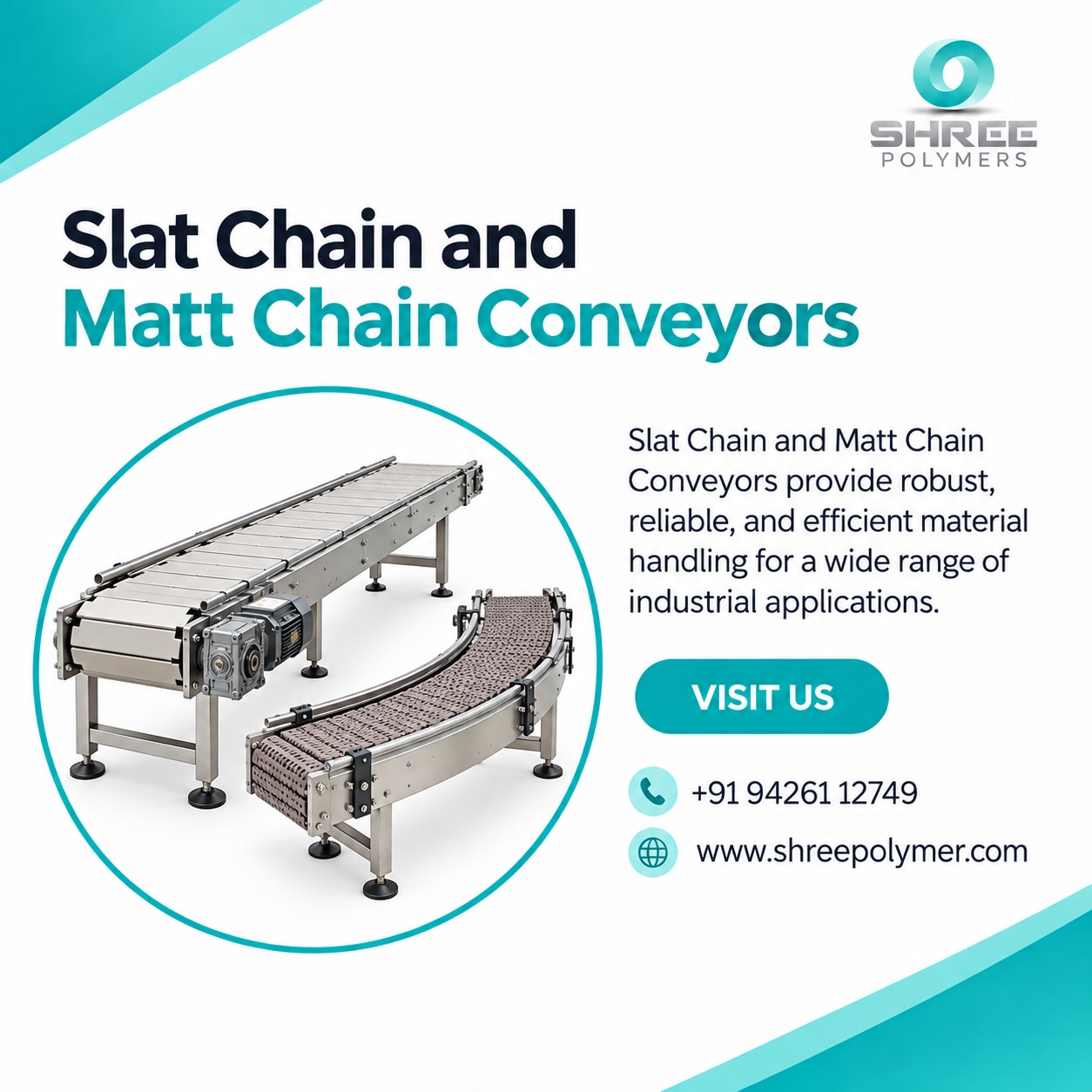 | Conveyors and Automation Slat Chain and Matt Chain Conveyors POLYSTEEL slat chain and matt chain conveyors are listed within the company’s conveyor systems offering for industrial material handling. |
How to prove smoother operation after installation
Acceptance is proven by a repeatable product run, not by a nameplate load test. The case for a slat matt chain conveyor for benefits in Ankleshwar rests on measured stability: it must feed packaging conveyor systems without jams, scuffing, unsafe access or unplanned stops.
1. Run the actual bottles, cans, cartons or cases at minimum and maximum line rates. Confirm speed against product pitch × products per minute, then test starts, stops, indexing, accumulation and recovery after a downstream stoppage.
2. Challenge every transfer, turn, noseover and dead plate with the least stable product. Record tipping, trapping, back pressure, gaps and rejected-product behaviour; a conveyor that carries the stated mass still fails if its transfer geometry jams containers.
3. Check guide-rail position, chain tension, sprocket engagement, slat or mat wear, lubrication points and motor temperature after a production-length trial. Inspect plastic components for detergent damage, swelling or cracking after the actual cleaning cycle.
4. Verify fixed guards over chains and sprockets, accessible emergency-stop devices, pull cords, restart alarms and interlocked access doors. Test lockout/tagout isolation at the drive before maintenance, and confirm that an emergency stop prevents automatic restart.
5. Save baseline speed, current draw, noise, vibration, transfer settings and product spacing. Repeat these checks at a defined interval; rising current, noise or spacing errors reveal deterioration before a jam becomes lost production.
Frequently asked questions
How do slat-chain and matt-chain conveyors differ at the product surface?
Slat-chain conveyors use linked metal or plastic slats with defined hinge gaps and pitch. Matt-chain conveyors use interlocking modular plastic links that form a more continuous contact surface.
Where do slat and matt chain conveyors improve packaging-line movement?
They suit packaging lines requiring controlled transfers, accumulation, container stability and routing around equipment such as fillers, labellers, case packers and wrappers.
How do chain conveyors compare with belts and rollers?
Chain conveyors provide positive drive and configurable layouts. Belts offer a continuous surface, while rollers suit rigid-bottom loads and accumulation; compare transfer gaps, cleaning, noise and product contact.
How should you choose a chain conveyor configuration?
Specify product dimensions and weight, line speed, accumulation length, conveyor width, chain material, sprocket arrangement, frame construction, transfer method, washdown needs and operating temperature.
How can you prove smoother operation after installation?
Record baseline and post-installation stops, transfer failures, speed variation, product damage, noise and accumulation performance under comparable production conditions.
Keywords