A roller that squeals, runs hot, sheds polymer, or changes belt tracking can indicate anything from a seized bearing to a misaligned frame or aggressive washdown. By the end, you will be able to separate those faults, inspect the line safely, specify a suitable replacement, and document the repair without repeating the original failure.
Key takeaways
- Check product buildup before condemning the roller bearing.
- Separate belt tracking, drive, and alignment faults from roller failure.
- Match seals and roller materials to food product and washdown chemicals.
- Record cleaning, alignment, and test-run evidence before releasing the line.
Match the symptom to the likely roller fault
A seized or overloaded bearing points to roller failure, but belt drift or slow output alone does not. A polymer-covered roller with product buildup can grow in effective diameter, increasing belt tension, rolling resistance, and tracking force before its bearing fails.
| Symptom | Likely fault | Check before replacing |
|---|---|---|
| Abnormal noise or heat | Seized bearing, corrosion, or contamination | Compare adjacent roller temperatures and listen under load |
| Vibration or rhythmic thumping | Bent shaft, shell eccentricity, cracked cover, or loose bearing seat | Measure roller runout and axial play |
| Scoring or cuts | Damaged polymer cover or abrasive product | Inspect the full face and roller ends |
| Swollen or cracked body | Chemical attack, moisture damage, or overload | Check cover hardness, thickness, and cleaning exposure |
| Reduced throughput or drag | Increased diameter from deposits, bearing resistance, belt tension, or drive fault | Turn the roller and check motor current |
| Belt tracking change | Uneven buildup, frame misalignment, pulley alignment, or unequal tension | Compare roller heights and belt alignment |
| Free-spinning roller off-line | Excessive clearance, loose fit, shaft deflection, or shell eccentricity | Test runout and rotation under belt load |
A roller can look intact and turn by hand yet deflect under load. Separate shaft corrosion, loose bearing seats, belt-tension faults, drive problems, and frame misalignment from bearing failure.
That distinction matters in diagnosing polysteel roller problems in food processing in Ankleshwar and food conveyor roller problems in Gujarat: replacing a nominally identical roller will not cure the original cause.
Inspect the conveyor without mistaking alignment or drive faults for roller failure
Start by removing product, stopping the conveyor, isolating every energy source, and applying lockout/tagout. Do not open guards until stored belt, gravity, pneumatic, and electrical energy is controlled. This prevents an alignment fault from becoming an injury during inspection.
1. Turn the suspect roller by hand, then compare it with the two adjacent rollers. Feel for roughness, tight spots, axial play, seal damage, corrosion, product deposits, loose mounts, and movement at the bearing seat.
2. Mount a dial indicator against the roller shell and record radial runout while rotating it. Measure shaft straightness, shaft-end geometry, and axial play; inspect the shell for eccentricity, swelling, cracks, scoring, or a loose cover.
3. Check belt tension and tracking, frame squareness, mounting height, and pulley alignment. A skewed frame or pulley can overload a sound roller and create food conveyor roller problems in Gujarat that appear to be bearing failures.
4. Compare the suspect roller’s temperature with adjacent rollers using an infrared thermometer at the same operating point. Record noise, vibration, belt drift, drive current, gearbox noise, oil leakage, and abnormal backlash before dismantling.
An unloaded roller can turn freely while excessive bearing clearance, a loose bearing fit, shell eccentricity, contamination, or shaft deflection appears only under belt tension and product load.
Record outside diameter, usable face width, shaft diameter and end geometry, runout, axial play, bearing fit, mounting dimensions, belt tension, temperature, current, and vibration trend before ordering parts. Separate bearing failure, shaft corrosion, polymer-cover damage, bearing-seat looseness, contamination, belt tracking, and drive faults; a nominally identical replacement will repeat the failure if the cause remains.
What sealed, no-lubrication rollers still need in a washdown plant
“No lubrication” means the bearing is sealed for life, not empty. It contains lubricant and is not intended for routine greasing. Drilling a hole or forcing grease past the seal can damage the seal, push in water and soil, and introduce contamination.
A sealed roller can fail when a high-pressure jet drives water, detergent, flour, sugar, oil, or salt past the end cap. Excessive temperature, chloride-bearing cleaners, stagnant residues, impact loading, and repeated wet-dry cycles accelerate grease loss, corrosion, swelling, and bearing damage.
For sealed conveyor rollers in Ankleshwar, specify nozzle distance, pressure, temperature, and prohibited spray directions around seals.
Keep the inspection checklist practical:
- Clean soil from around seals and end caps without directing the jet into them.
- Check for water or detergent ingress, trapped residues, and blocked drains.
- Inspect shafts, bearing seats, end caps, and mounting interfaces for corrosion, looseness, or scoring.
- Watch for heat compared with adjacent rollers, abnormal noise, vibration, and rough rotation.
- Remove the roller when the seal is damaged or internal bearing condition cannot be confirmed; do not inject grease.
ISO 14159 principles make exposed threads, crevices, sharp steps, blocked drains, and hollow sections that cannot drain both hygiene and reliability risks. “Sealed” does not mean washdown-rated or IP-rated: request washdown, chemical-resistance, and ingress-test evidence before approval.
Specify the replacement for the actual food product and cleaning regime
Approve a replacement only after matching the actual food product and cleaning regime. “Polysteel” alone identifies neither polymer chemistry nor food-contact suitability. The specification must cover the complete wetted assembly, including bearings, grease, adhesive, end caps, shaft coatings and possible wear debris.
1. Record the product, radial load, conveyor speed, roller spacing, impact, operating temperature and the food-contact status required for the zone. Measure outside diameter, usable face length, shaft diameter, shaft-end geometry, mounting height, bearing arrangement, conveyor pitch, shell or tube thickness and polymer-cover thickness.
2. Require the polymer family, hardness, additives, shell or tube material, shaft material, bearing series and fit, end-cap design and adhesive. Ask for compatibility data against the named detergent and sanitizer, their concentrations, washdown temperature, exposure time, nozzle pressure and spray direction.
3. Treat sustained heat and moisture as a hydrolysis risk for polyester-based polyurethane. Chemicals can swell, soften, crack or detach a covering even when its surface appears sound; chloride-bearing residues can pit stainless steel at shafts, shells and bearing seats.
4. For polysteel roller replacement in Ankleshwar, give Shree Polymers these measurements and cleaning details when requesting compatibility and dimensional documentation. Use the same evidence when comparing sealed conveyor rollers in Ankleshwar; “sealed” does not prove chemical, pressure or food-contact suitability.
5. Reject approval if the supplier cannot identify the finished assembly’s food-contact declaration, use limits, interchange dimensions or cleaning compatibility. A material label is not a validation record.
Related product
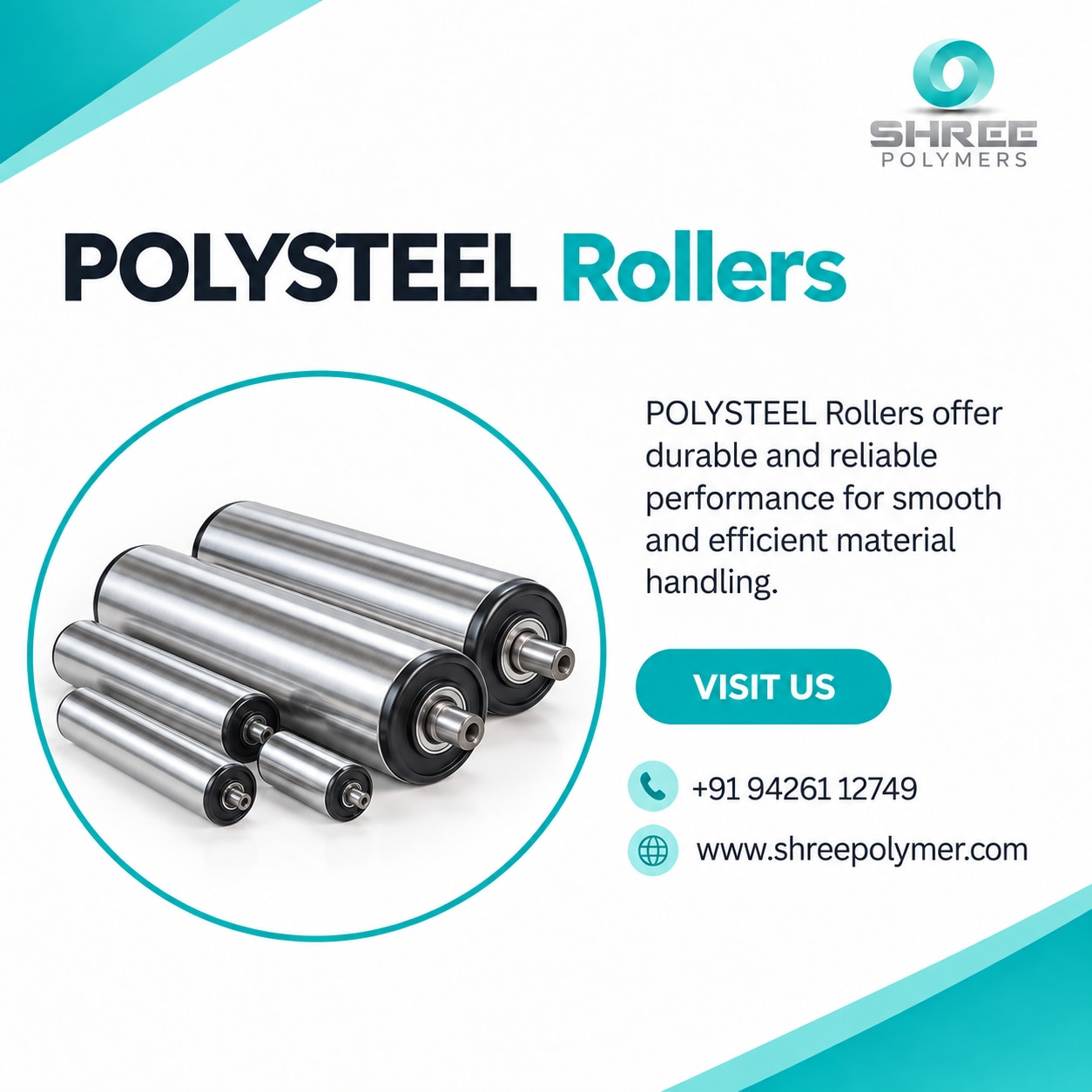 | Material Handling POLYSTEEL Rollers use a surface designed to resist build-up and sealed-for-life bearings that do not require lubrication. |
Replace, align, and release the roller with evidence of a clean repair
A clean repair starts before the old roller moves. For polysteel roller replacement in Ankleshwar, remove product from the conveyor, isolate every energy source, apply lockout/tagout, and verify zero movement. Sanitize the exposed area before dismantling so product soil does not enter the bearing seats.
- Remove guards and extract the shaft without forcing it through a seized bearing. Tag the roller’s position and inspect the frame, mounting holes, shaft shoulders, drains, and fasteners for distortion, corrosion, looseness, or blocked cleaning paths.
- Install the specified roller, checking outside diameter, usable face width, cover thickness, shaft ends, bearing series, and fit against the purchase drawing. Seat the shaft fully; a loose bearing fit or trapped shoulder will create runout.
- Refit bearings and guards, then align the belt without using excessive tension to hide tracking error. Confirm mounting height and conveyor squareness.
- Before release, measure radial runout with a dial indicator and check axial play. Rotate the roller by hand, then run it unloaded and under normal product load while recording belt tracking, noise, vibration, temperature, rolling resistance, and throughput.
- Clean again after testing. Remove metal particles, polymer fragments, grease, and old product soil from the roller, frame, belt, guards, and floor, then document the inspection and release decision.
The record for polysteel roller problems food processing in Ankleshwar must name the cause: bearing failure, contamination, shaft corrosion, polymer-cover damage, overload, misalignment, belt tension, or cleaning chemistry. Otherwise, an identical replacement can repeat the failure.
Frequently asked questions
How do you identify a polysteel roller problem in a food conveyor?
Match the symptom to the fault: a seized bearing indicates roller failure, while belt drift or slow output alone can point to alignment, drive, or product buildup. Inspect the roller surface, bearing movement, belt tension, and buildup before replacing it.
How can you avoid mistaking alignment or drive faults for roller failure?
Check frame squareness, roller parallelism, belt tracking, drive speed, pulley condition, and belt tension. A roller replacement will not correct a misaligned conveyor or an underperforming drive.
Do sealed conveyor rollers in Ankleshwar need lubrication?
No-lubrication conveyor rollers still need inspection and cleaning. Washdown staff must remove product buildup, check damaged seals, look for corrosion, and confirm that cleaning chemicals and water pressure have not compromised the bearing.
How should you specify a polysteel roller replacement in Ankleshwar?
Specify the food product, temperature, moisture, cleaning chemicals, washdown frequency, roller dimensions, load, speed, shaft arrangement, bearing seal, and required surface finish. Use those conditions to select the cover and bearing construction.
Keywords