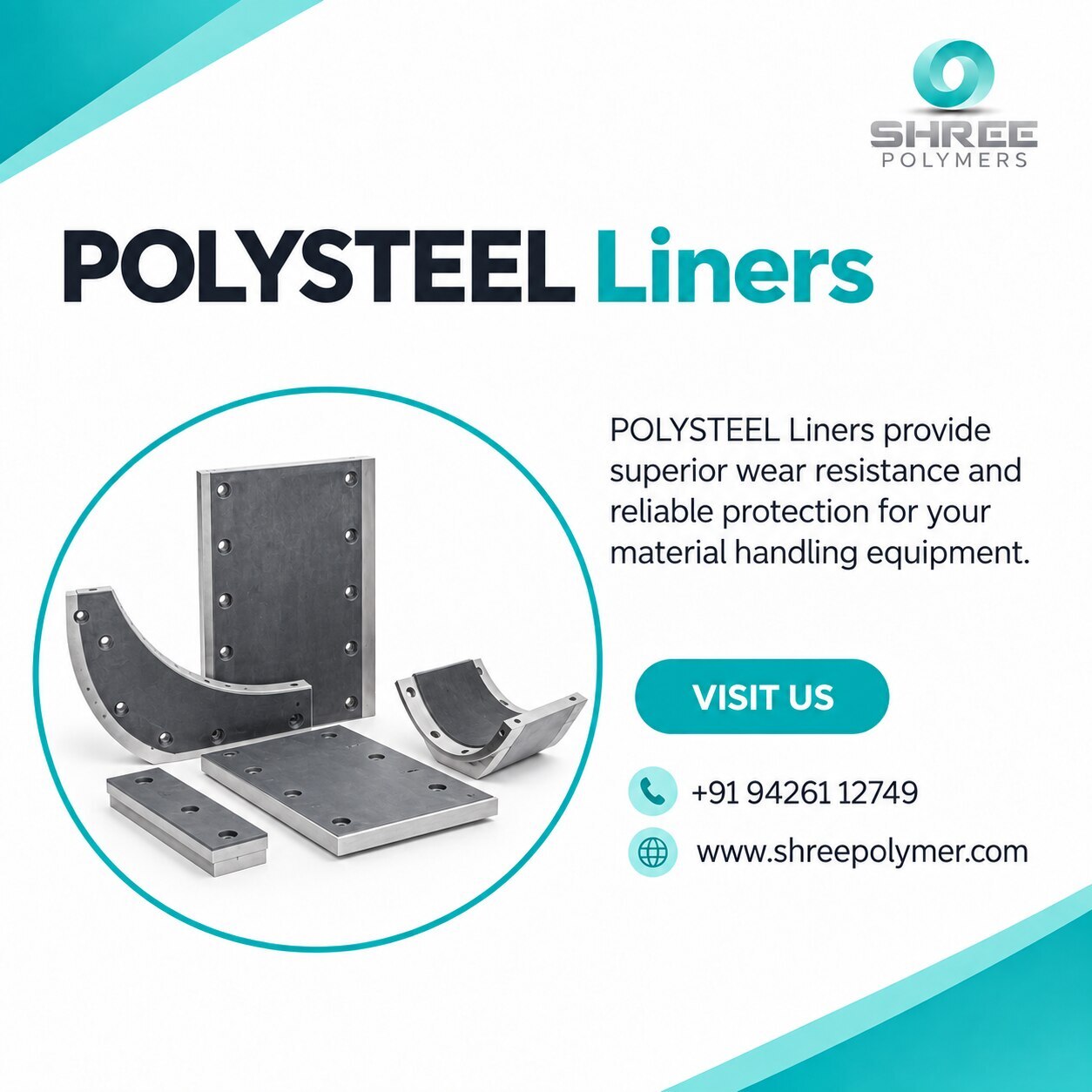
A “polysteel liner” is not a complete purchase specification. Before you compare quotations, define the polymer, steel backing, duty conditions, test methods, panel geometry, fastening layout and replacement criteria so the selected liner matches the material and chute rather than only the product name.
Key takeaways
- Name the polymer, steel grade, thicknesses and bonding method.
- Size chute liner thickness for impact energy, flow rate and replacement access.
- Check temperature, chemicals, fasteners and water ingress before installation.
- Send chute drawings, material data and wear history before fabrication.
What must a complete polysteel liner specification contain?
A purchase specification must name the wear layer—UHMW-PE, HDPE or polyurethane—polymer thickness, steel grade, backing thickness and bonding method. State whether it is a bonded composite or a polymer sheet mounted over steel with separate fasteners; these constructions differ in bond integrity, water ingress and repairability.
In polysteel liner specifications in ankleshwar, treat POLYSTEEL-N and POLYSTEEL-W as supplier-specific labels until datasheets define formulation, hardness, temperature range and abrasive duty.
Require a certificate or datasheet with these measurable values:
| Material property | Supplier must state |
|---|---|
| Material grade | Exact polymer and steel grades |
| Density | Value in g/cm³ and test method |
| Hardness | Value, scale and test method |
| Tensile strength | Value, direction and test method |
| Impact strength | Value and test method |
| Abrasion result | Wear loss, test method and conditions |
| Coefficient of friction | Value, test method and counterface |
ASTM G65 is a recognised dry sand/rubber-wheel abrasion method, not a service-life prediction for a wet or impact-dominated chute. Ask for virgin-material status when recycled or mineral-filled content is unacceptable.
- Define liner life by a measurable failure: specified wear loss, exposed backing, leakage, unacceptable flow restriction or increased conveyor power.
- Record available sheet thicknesses, panel dimensions, weight per square metre, cutting and drilling tolerances, maximum unsupported span and permissible joint gap.
- Specify countersink depth, fastening-hole layout, operating-temperature range and edge-sealing requirements.
These details turn industrial conveyor liner specifications from a trade-name request into an inspectable purchase document.
How do you select liner thickness for a transfer chute?
Choose thickness by zone and duty, not by chute name or hardness alone. For abrasive material handling liners, give the supplier the material name, bulk density, maximum lump size, particle shape, quartz or glass content, moisture, throughput, chute angle, transfer angle, feed height, belt width, loading-point geometry and operating temperature.
Separate sliding abrasion from impact abrasion. A fine, dense stream sliding across a floor wears the surface differently from sharp rock falling onto the first receiving panel. Specify thicker or tougher panels at the loading-point impact zone, impact curtain and first receiving section; use thinner panels on low-impact side walls where the design permits.
Request a duty calculation showing how particle size, bulk density, drop height and throughput determine impact energy. Ask for thickness by zone, not one nominal thickness for the whole chute.
UHMW-PE suits low-friction sliding and damp-material release. Polyurethane deserves consideration where repeated impact, gouging or elastic recovery dominates. Neither is automatically suitable for hot feed or sharp-edged ore.
| Material | Wear and handling profile | Check before selection |
|---|---|---|
| UHMWPE | Low friction; good sliding service; lighter cutting effort | Temperature and sharp-lump impact |
| Polyurethane | Better elastic recovery for repeated impact and gouging | Sliding wear rate and chemical compatibility |
| Ceramic or chromium-carbide plate | Severe sliding-wear resistance | Impact cracking and installation time |
| Rubber | Strong impact tolerance and low noise | Friction, weight and temperature |
| Mild or stainless steel | Heat tolerance; higher friction and noise | Wear rate, weight and replacement effort |
Which temperature, chemical and installation conditions can cause failure?
Failure starts when a liner rating is treated as a service limit. Write continuous temperature, peak temperature and exposure duration into the specification; a generic UHMW-PE or polyurethane rating does not prove suitability under load.
| Condition | Failure risk | Specification requirement |
|---|---|---|
| Heat cycling | Expansion buckles sheets and lifts joints | State temperatures, duration, joint allowance and fastener clearance |
| Aqueous chemicals | Swelling or degradation from contaminants | Review the exact formulation against process chemistry |
| Solvents or oxidisers | Cracking, softening or rapid wear | Obtain documented compatibility approval |
| Wet, oily or corrosive solids | Hidden attack and poor adhesion | Request immersion or chemical-compatibility data |
Polyethylene handles many aqueous acids, alkalis and salts, but strong oxidisers and some aromatic or halogenated solvents need a documented review. Reject “chemical resistant” without formulation-specific evidence.
For polysteel liner specifications in Ankleshwar, approve an installation drawing that shows:
- Recessed or countersunk fasteners, recess depth and maximum head projection
- Hole positions, support spacing, edge sealing and replacement sequence
- Joint gaps sized for polymer movement; tightly butted sheets can buckle against steel
- Joints aligned with material flow, with no panel corner facing falling rock
- Corner transitions without abrupt lips; overlap only away from flow and without a step
- Clearance before gates, skirts and outlets for movement and cleaning
A bonded composite also needs bond-integrity, steel-backing, edge-sealing and water-ingress requirements. Tightening an accessible bolt will not repair a loose polymer skin. These details separate durable abrasive material handling liners from panels that fail at joints, corners or fasteners.
How should you inspect, clean and replace a worn panel?
Before commissioning, create a baseline record for the industrial conveyor liner specifications: photograph every joint, mark a measurement grid, record panel thickness, measure countersink depth, and note fastener type and torque requirement.
| Inspection point | Record or check | Corrective trigger |
|---|---|---|
| First impact zone | Wear depth and gouging | Wear approaching the drawing limit |
| Edges, corners and joints | Support, movement and gaps | Unsupported edge, open joint or panel movement |
| Fasteners | Looseness, rotation, corrosion, head damage and trapped material | Raised or damaged head, or lost torque |
| Outlets and terminations | Leakage and flow clearance | Restricted path or exposed backing |
During each planned shutdown, isolate the conveyor and clean the surface with a method compatible with the polymer. Use a depth gauge or an ultrasonic thickness method approved for the construction, then compare remaining polymer with the drawing’s minimum wear limit.
A delaminated edge, gouge reaching the backing or crack through the wear layer needs corrective action, not cosmetic patching. Replace the panel when it reaches minimum wear thickness, exposes steel, allows leakage, restricts flow or loses support.
Record wear as millimetres per operating hour or tonne handled; “expected life” is not a measurement. Before ordering abrasive material handling liners, plan labour, lifting access, confined-space controls, isolation time, cleaning and disposal. Keep labelled spares cut and drilled to the approved drawing.
Matching the hole pattern prevents enlarged holes and protruding fasteners that create new snag points.
What should you send to an Ankleshwar supplier before fabrication?
1. Give a polysteel liner manufacturer in Ankleshwar a dimensioned chute drawing, belt width, transfer angle, gate and outlet locations, access restrictions, chute photographs and a marked-up wear map. Include material name, bulk density, maximum lump size, flow rate, feed height, moisture, oil or chemical exposure, continuous and peak temperature, operating hours and panel-failure history.
2. Record the present liner material, thickness, time in service, failure location and failure mode: sliding wear, impact gouging, cracking, delamination, loose fastening or flow restriction. For polysteel liner specifications in Ankleshwar, identify dusty solids, monsoon moisture, wash-down water, oils, corrosive residues and hot material separately; approve each condition against the chosen polymer grade.
Ask for a site measurement or template review before manufacture.
3. Require an approved fabrication drawing with panel numbers, orientation, dimensions, tolerances, hole coordinates, countersink geometry, joint gaps, overlap direction, unsupported-span limits, corner transitions, termination clearances and replacement sequence. Shree Polymers is relevant only if it reviews those duty inputs and supplies this drawing with material documentation.
On delivery, compare panel length, width, thickness, backing plate, hole pattern, countersink depth, edge condition and identification with the approved drawing before dispatching panels to site.
Related product
 | Material Handling POLYSTEEL Liners POLYSTEEL liners are presented for bulk material handling systems to help address jamming, choking and rat-holing in hoppers, chutes, bins and... |
Frequently asked questions
What must a complete polysteel liner specification contain?
State the wear-layer material—UHMW-PE, HDPE or polyurethane—polymer thickness, steel grade, backing thickness, panel dimensions, tolerances and bonding or fastening method. Identify whether the liner is a bonded composite or a polymer sheet mounted over steel with separate fasteners.
How do you select liner thickness for a transfer chute?
Base thickness on particle size, bulk density, drop height, impact angle, throughput, chute geometry and expected wear rate. Use thicker panels in direct-impact zones, then confirm clearances, panel weight and access for replacement.
Which conditions can cause a polysteel liner to fail?
Check the polymer temperature rating against material and cleaning temperatures. Review exposure to oils, solvents, acids and alkalis, then control water ingress, substrate corrosion, incorrect fastener spacing, poor surface preparation and unsupported panel edges.
How should you inspect, clean and replace a worn panel?
Inspect for gouging, cracking, swelling, loose fasteners, debonding, exposed steel and blocked flow paths. Remove abrasive buildup with a suitable non-damaging method, record panel locations and replace sections when wear threatens the backing, fasteners or chute profile.
What should you send to an Ankleshwar supplier before fabrication?
Send chute drawings with dimensions and bolt-hole locations, material name and bulk density, particle size, throughput, drop height, operating temperature, chemical exposure, cleaning method, liner history, access limits and photographs of worn areas.
Keywords