A guide rail must keep each pack aligned without becoming a source of friction, scuffing, tipping or jams. By the end, you will be able to compare fixed rails, adjustable systems, side belts, dead plates and change parts, prepare a usable quotation request, and judge whether a standard or custom solution fits your line.
Key takeaways
- Match rail geometry to pack shape, weight, speed and handling operation.
- Give suppliers conveyor width, pack dimensions, line speed and mounting details.
- Choose UHMW-PE, stainless steel or engineered polymer for the environment.
- Validate clearance, supports and transfers with loaded packs before production.
Which guide system fits the product and conveyor job?
Choose containment from the pack’s stability, mass, shape, speed and process operation—not from the rail profile alone.
| Option | Best fit | Main control and risk |
|---|---|---|
| Fixed rails | One SKU with stable dimensions and repeatable positioning | Specify the rail centreline and use positive brackets; do not depend on sliding adjustment |
| Adjustable rails | Multiple container diameters or widths | Set from a machine datum with a readable scale, repeatable bracket positions and a positive lock; a friction-only knob can move under vibration or accumulation pressure |
| Side belts | Tall, narrow or unstable packs on a long run | Provide continuous lateral support; define belt contact area, speed and maximum side force |
| Cleated side belts | Controlled indexing or separation | Add timing control, but accept more moving parts and cleaning points |
| Dead plates | Short transfers between conveyors | Use only where the pack remains supported and the gap is controlled; they cannot replace a conveyor bed or long unsupported span |
| Change parts | A filler, labeler, timing screw, star wheel or case packer needing SKU-specific geometry | Define the exact profile and changeover setting |
For the selected system, record whether accumulation is permitted, maximum side force, product-contact area, operating speed and acceptable cosmetic marking. A glass bottle may need low-impact containment; a pouch or tall PET bottle may need continuous support to prevent tipping, while excessive pressure can scuff or deform any pack.
Custom conveyor guide rails earn their cost when several SKUs, unusual shapes, constrained machine interfaces or tight transfer zones make a standard profile unreliable. Keep rail loads separate from conveyor-bed support loads: the guide contains and aligns the pack, while the conveyor supports its mass.
What measurements make a guide-rail quotation usable?
A quotation needs a measured interface drawing, not just a nominal bottle or carton size. Survey the existing conveyor using the frame centreline and product-support plane as primary datums, then record:
- Minimum and maximum product diameter or width, overall height, mass, centre of gravity, pack shape, line speed, lane count and smallest curve radius.
- Conveyor width, chain type, rail height, rail offset from the conveyor centreline, transfer-gap dimensions, product pitch, accumulation length and datum points at adjacent machines.
- Every mounting-hole position, clamp location, bracket height, rail centreline, adjustment travel and clearance from the pack.
Mark photoelectric sensors, reject mechanisms, label heads, filler nozzles, timing screws, guarding and operator access. Show the rail profile, fastener direction, bend radius, transfer clearances and the envelope occupied by adjustment hardware.
Photograph a straight section, every transition and the smallest curve, then check each photograph against the drawing. A request for a custom guide for rail manufacturer in ankleshwar must state whether the rail provides lateral guidance only or whether another structure supports the product. Define rail loads, bracket loads, conveyor-frame stiffness and product-support requirements separately.
Otherwise, a rail designed for alignment can be overloaded as a conveyor bed. Include transfer and curve dimensions because a guide that fits the straight section can still jam packs at the first radius.
Which rail material survives the line environment?
The rail face takes the friction and impact; the backing carries load and holds alignment. Compare both against wear, temperature, chemicals, static, cleanability and the pack’s surface before choosing a material.
| Material | Strengths | Failure risks and checks |
|---|---|---|
| UHMW-PE | Low friction and abrasion resistance for many product-contact guides | High thermal expansion can bow long rails; use floating mounts, expansion gaps or segments |
| POM or acetal | Stiffer and more dimensionally stable for precise, small-profile guides | Check oxidisers, solvents, cleaners and operating temperature |
| Nylon | Useful impact resistance | Moisture absorption can change dimensions and performance |
| Stainless steel | Strength and cleanability | 316 still needs control of chlorides, weld discoloration, crevices, stagnant wash water and concentrated cleaners |
| Aluminium-backed polymer | Stiff mounting with a replaceable low-friction face | Let the polymer and aluminium move differently at their interface |
Match the contact face to the pack. Glass needs a smooth, low-impact surface and inspection for chips or point loading; excessive pressure scuffs or deforms PET and pouches, while abrupt profiles make cans rotate or bridge. Cartons and jars need lateral support without crushing printed surfaces.
Control static where dust, labels or sensors are affected, and specify drainage and finish for washdown.
For food or beverage contact, request the exact resin, additive and colourant declaration, not merely “food safe.” Check 21 CFR 177.1520, Regulation (EC) No. 1935/2004 and Regulation (EU) No. 10/2011 where applicable. An industrial guide rails in Ankleshwar specification should also state chemical vapours, humidity, dust, cleaning method and temperature cycling.
How should clearance, supports and transitions be validated?
Set clearance as a process parameter using the lightest, least stable and most dimensionally variable approved pack. Too little space increases friction, scuffing, tipping and jams; too much permits yaw, rotation and loss of registration at fillers, labelers and case packers.
Define each SKU setting from the same machine datum, lock both sides, and record the adjustment position during changeover.
Size adjustment travel from the full product envelope, including height, shape, tilt and movement—not only the difference between nominal diameters or widths. Trial the final rail installation at operating speed, through start-stop cycles and at maximum permitted accumulation pressure. Watch for these failures:
- Bottle tipping, pouch folding, carton bridging, jar rotation, can spin and glass impact.
- The smallest transfer gap and every curve, including the rail’s final bend and mounting position.
- Deflection and vibration at the maximum unsupported length using a loaded trial or calculation. Section stiffness, material, side force, speed, accumulation and bracket stiffness determine spacing; a catalogue interval does not.
| Validation point | Required check | Failure prevented |
|---|---|---|
| Rail hardware | Keep fasteners outside the product path; remove sharp profile changes and support long cantilevers | Scratches, snags and impact |
| Long polymer rails | Allow thermal movement with floating mounts, gaps or segments | Buckling and misalignment |
| Machine interfaces | Clear sensors, rejectors, star wheels, timing screws, nozzles, guards and cleaning access | False detection and blocked operation |
| Product support | Verify the conveyor bed carries pack weight separately from the rail | Rail overload and sag |
How do you compare suppliers and decide whether customisation is justified?
Compare suppliers on documented performance and changeover control, not profile appearance or price alone. Ask every packaging machine guide rail supplier for a dimensioned drawing, material grade, chemical-compatibility statement, temperature range, adjustment travel, bracket spacing, fastener specification and design evidence.
| Option | Choose it when | Main check |
|---|---|---|
| Standard profile | One stable container runs on a straight conveyor | Replacement availability, bracket fit and lead time |
| Custom assembly | Mixed SKUs, unusual geometry, washdown chemistry, tight interfaces or constrained transfers create measurable failure risk | Trial results, load assumptions and repeatable settings |
| Local supplier | Site measurement, trial fitting and rapid correction matter | Response time, inspection records and acceptance support |
Require a defined datum, readable position indicators, positive locking and repeatable clamp locations. Tool-less handwheels shorten changeovers only when threads stay clean and locking force is adequate; high-speed or high-accumulation lines need a positive clamp or secondary lock rather than friction alone.
Put these details in the RFQ:
- Line speed, product temperature, dry or wet operation, cleaning chemicals, humidity, abrasive dust, static, load, impact, continuous or intermittent duty, changeover time and acceptable marking.
- Direct rail contact, permitted accumulation, maximum side force, corrosion exposure and product-support requirements. Specify rail loads, bracket loads and conveyor-frame stiffness separately.
- Material certificates, food-contact declarations where relevant, dimensional inspection records, adjustment-repeatability evidence and factory or site trial results.
Shree Polymers is one Ankleshwar option to compare using the same drawing, load assumptions, material evidence and acceptance test as every other adjustable guide rail manufacturer. That makes an industrial guide rails in Ankleshwar comparison technically meaningful, including when searching for a custom guide for rail manufacturer in Ankleshwar.
Related products
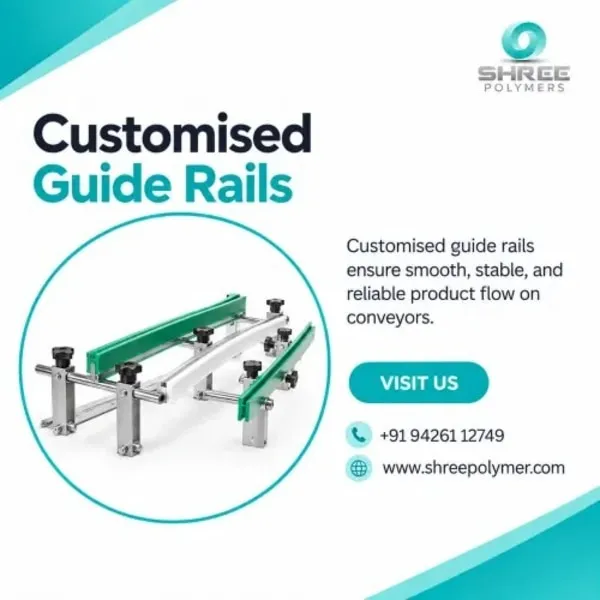
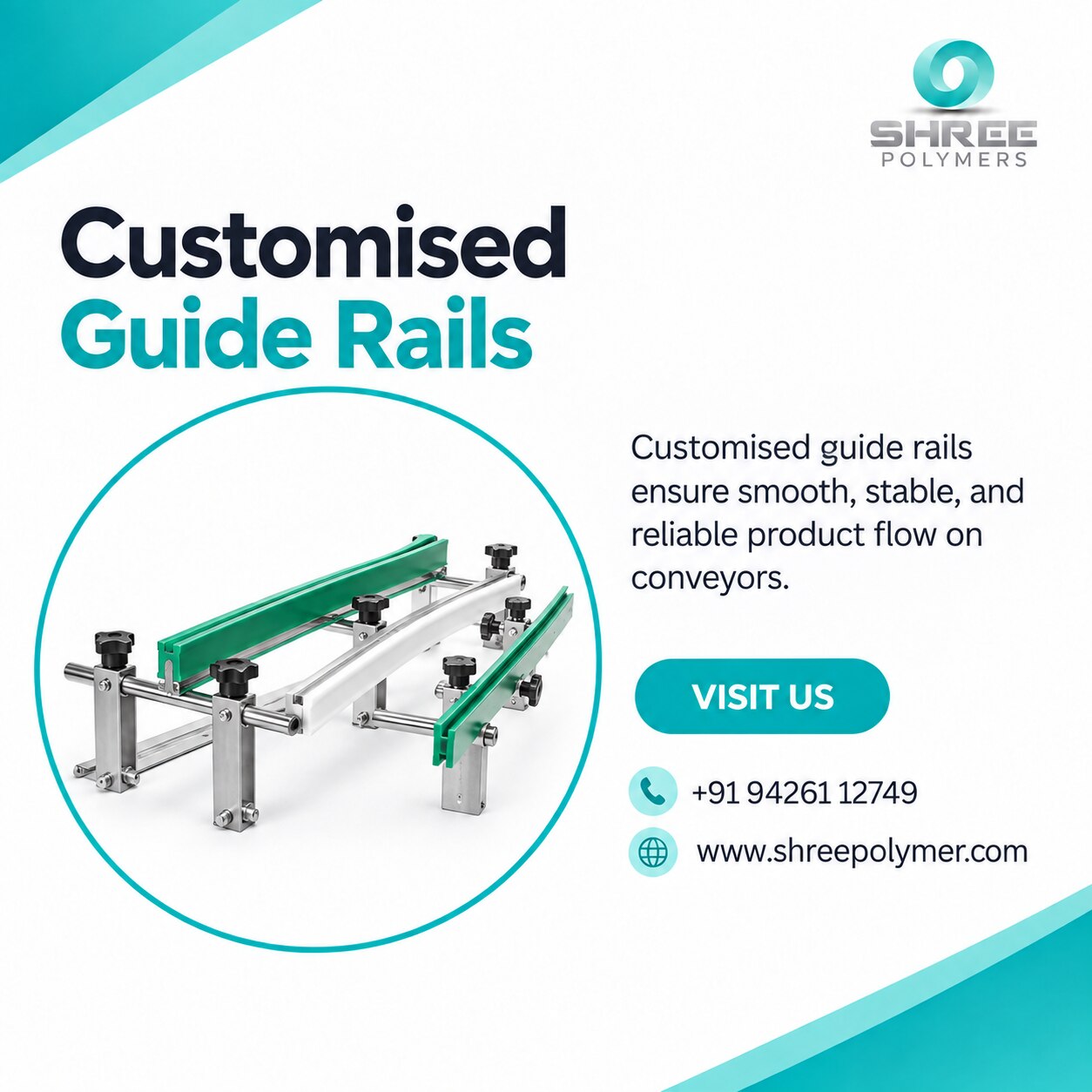 | Guides and Change Parts Customised Guide Rails POLYSTEEL guide rails are made to customised sections for conveyor systems requiring tailored guide-profile geometry. |
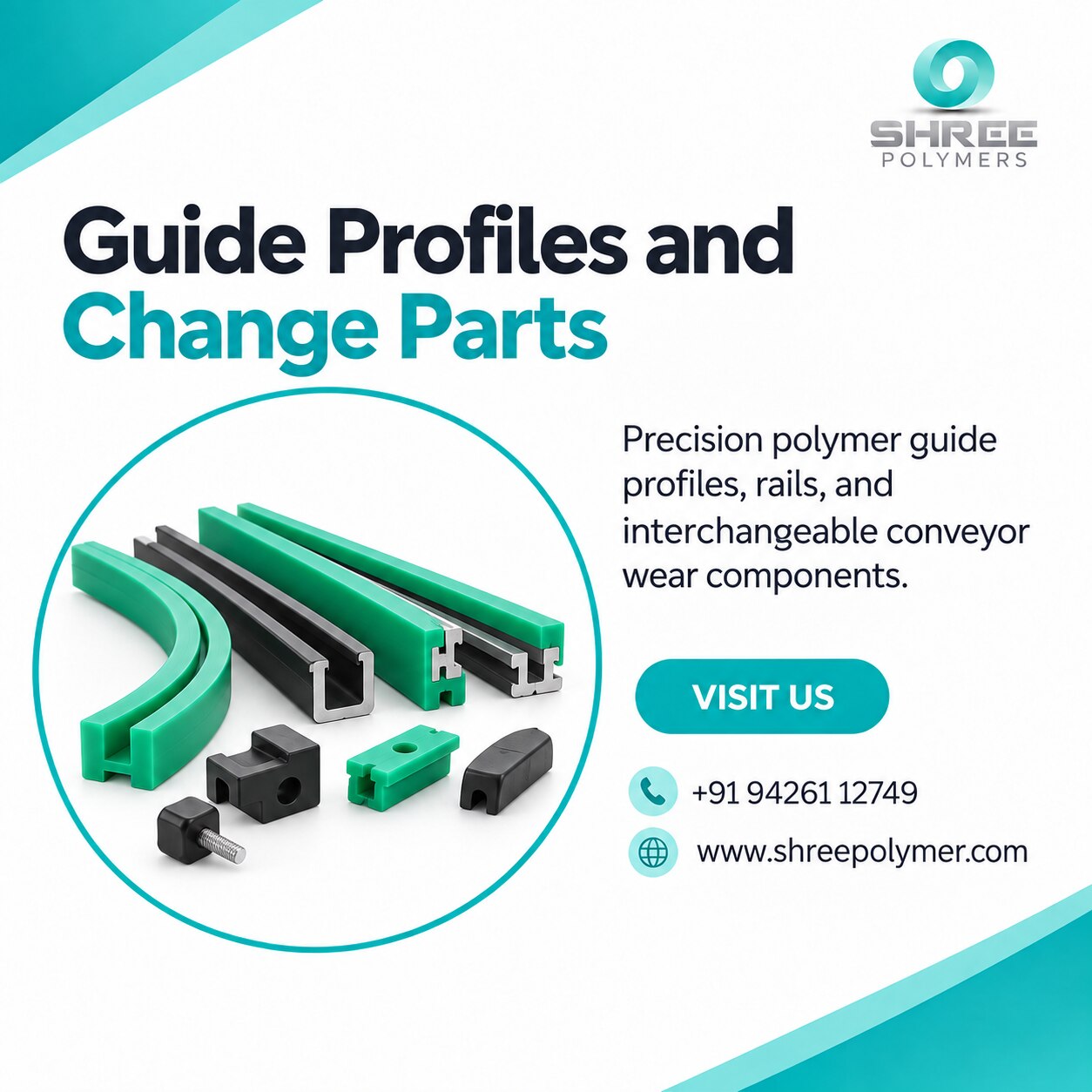 | Guides and Change Parts Guide Profiles and Change Parts Shree Polymers manufactures customised change-over parts for segmented industrial applications including packaging, food, pharma and bottling. |
Frequently asked questions
Which guide system fits the product and conveyor job?
Choose fixed, adjustable, side-grip or profiled guides according to the pack’s shape, mass, stability, speed and process operation. Adjustable guides suit changing pack widths; profiled guides suit repeatable container geometry.
What measurements make a guide-rail quotation usable?
Provide pack length, width, height, weight, conveyor width, belt or chain type, line speed, guide height, required clearance, conveyor direction and mounting-point locations. Include drawings or photographs showing infeed, discharge and transfer sections.
Which rail material survives the line environment?
Use UHMW-PE for low-friction contact, stainless steel for corrosion resistance and washdown exposure, and engineered polymers when the line needs controlled wear or product protection. Check chemical exposure, temperature, abrasion and cleaning method before selecting the material.
How should clearance, supports and transitions be validated?
Test the largest and smallest packs under operating speed and load. Check that guides do not pinch, scuff, tip or stall packs, and inspect every transfer, curve, height change and gap between rail sections.
How do you compare suppliers and decide whether customisation is justified?
Compare suppliers on dimensional drawings, mounting details, material specification, adjustment range, lead time, replacement parts and commissioning support. Customisation is justified when standard rails cannot maintain stable clearance through the actual conveyor route.
Related product
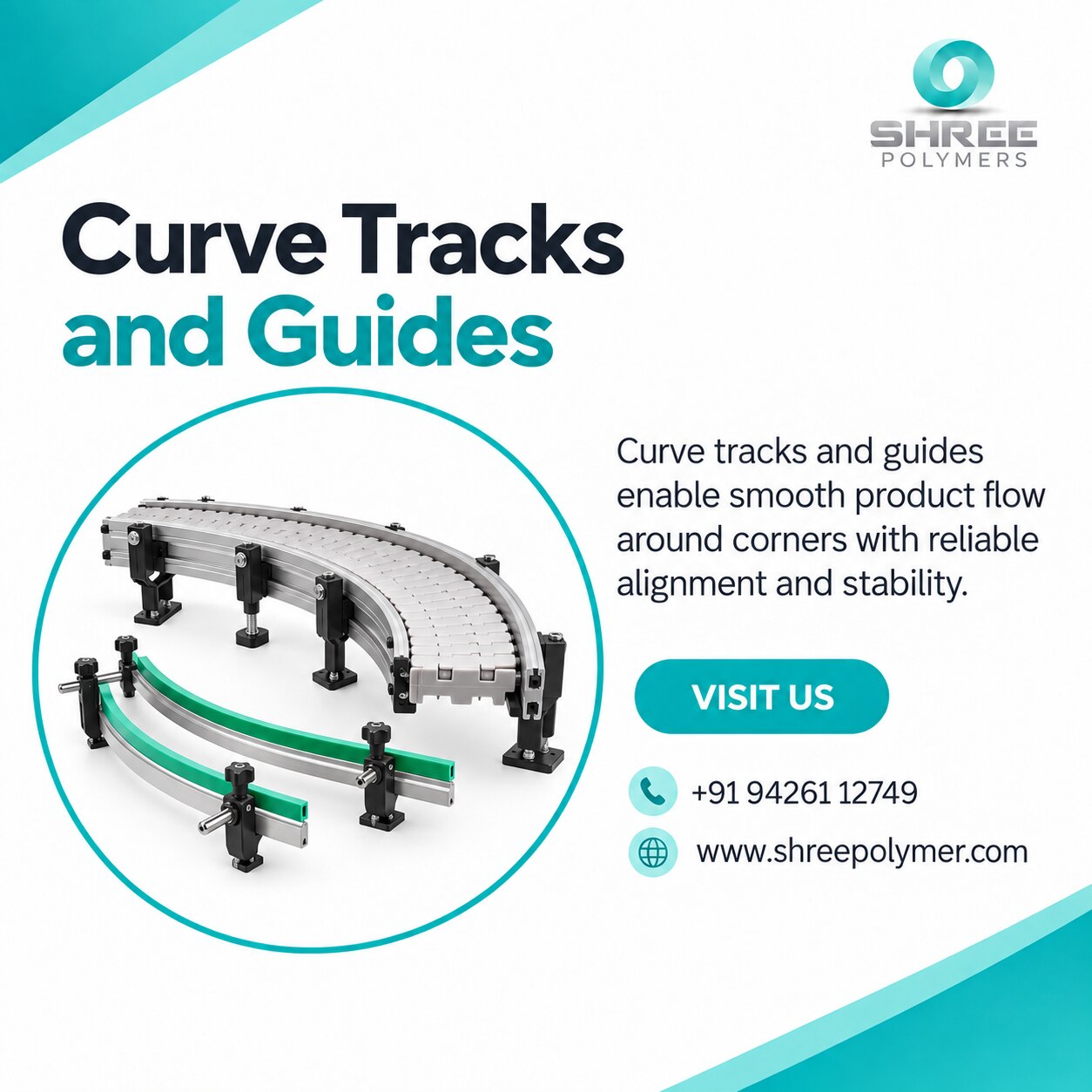 | Guides and Change Parts Curve Tracks and Guides POLYSTEEL curve tracks and guides, also called corner tracks or corner bends, connect conveying routes arranged at 90 degrees. |
Keywords