

The right pick-and-place arrangement depends on product presentation, payload, motion, placement accuracy and the complete packaging cell—not the robot’s advertised cycle rate. You will be able to compare robot, gantry, SCARA, delta and pneumatic systems, define the figures suppliers must prove, and select a cell that remains reliable during changeovers and production faults.
Key takeaways
- Measure good parts per minute, not the robot’s empty cycle time.
- Choose delta, SCARA, gantry, robot or pneumatic systems by reach and payload.
- Specify product variation, gripper type, orientation and placement accuracy before quoting.
- Test complete-cell output, changeovers, reject handling and maintenance access before installation.
How the pick-and-place cycle controls real output
Real output is good parts per minute at the required payload, reach, orientation and placement accuracy—not the robot’s maximum empty cycle. Each cycle starts as products arrive on the infeed, are detected and identified, gripped, transferred, placed and released before the next pick begins.
Industrial pick and place systems lose speed when presentation is poor: uneven spacing, unstable orientation or overlapping products can starve the robot.
| Format | Suitable handling | Main presentation constraint |
|---|---|---|
| Cartons and cases | Vacuum or jaw loading | Squareness, pitch and flap clearance |
| Pouches | Gentle jaws or tested vacuum | Flexible, shifting surfaces |
| Bottles | Neck or body gripping | Upright orientation and spacing |
| Trays | Vacuum or mechanical tooling | Nest position and stack separation |
| Irregular components | Vision with six-axis or custom tooling | Defined datum and orientation |
Specify lane spacing, conveyor pitch, product orientation, accumulation capacity and singulation method. State whether overlaps or incorrectly oriented products stop, bypass or enter a reject lane. Upstream rejection must keep defects out of the pick window; downstream accumulation must absorb short stoppages.
For conveyor-mounted picking, require encoder resolution, camera-to-pick latency, tracking-error tolerance, allowable belt-speed variation and the response to a missed window. A stationary demonstration proves nothing about moving-conveyor performance. Treat a quoted cycle with suspicion if it excludes:
- Vision acquisition, infeed gaps, release time, carton indexing, rejects and changeover.
- Good parts per minute during a sustained run, including payload, reach, accuracy and representative product variation.
Robot, gantry, SCARA, delta or pneumatic: which arrangement fits?
Delta robots suit rapid top-loading of light, rigid products with simple approach angles; six-axis robots justify their cost when insertion is tilted, access angles change, or case packing is complex.
| Architecture | Motion, payload and reach | Best fit |
|---|---|---|
| Delta | Very fast parallel motion; light-to-medium payload and limited orientation | Top-loading rigid products |
| SCARA | Predominantly horizontal motion; useful reach and payload | Flat placement, assembly and repetitive loading |
| Six-axis | Multiple angles, broad reach and flexible orientation | Irregular components, tilted insertion and complex case packing |
| Cartesian gantry | Predictable linear travel across large rectangular areas | Large workspaces, fixed grids and straightforward access |
| Pneumatic | Fixed strokes with economical hardware | Repetitive transfers where air pressure, cushioning, timing and product variation stay controlled |
Compare the complete moving load, not the robot’s headline payload. Product, gripper mass, brackets, hoses, sensors, centre-of-gravity offset and wrist inertia all reduce allowable acceleration and can shorten service life.
A standalone machine fits a bounded operation with clear infeed and outfeed. Choose a conveyor-mounted unit when pitch and tracking are controlled; choose a carton-loading arrangement when forming, loading and handoff must stay synchronised. A full robotic cell earns its complexity when vision, packing, sealing, rejection and downstream handshaking operate together.
For primary-product handling, washdown construction and controlled contact materials can determine suitability. Secondary case packing prioritises reach, carton squareness and payload. Industrial pick and place systems should be specified around the actual product and placement requirement, then tested by a pick and place automation supplier at production speed rather than an empty cycle.
Grippers, product conditions and the accuracy you must specify
Choose the gripper by the product’s surface, not the robot’s advertised speed. Vacuum cups are compact and fast on smooth, rigid surfaces; porous cartons, films, powders, perforated trays and rough surfaces leak air. Mechanical jaws handle products that cannot hold vacuum, but excessive contact pressure can mark pouches, deform cartons or disturb loosely filled packs.
| Gripper | Best fit | Main failure or risk |
|---|---|---|
| Vacuum cups | Smooth, rigid products | Leakage causes drops; nominal vacuum alone does not prove a secure grip |
| Mechanical jaws | Porous, rough or irregular products | Pressure marks, deformation or movement of loose contents |
Test a custom pick and place machine with the smallest and largest products, worst surface texture, full payload and highest acceleration. Record:
- Contact area, gripping force, vacuum level at the cup and permitted leakage limit
- Vacuum-sensing threshold, loss-of-vacuum fault response and defined safe state
- Placement tolerance in millimetres, product drop height and acceptable orientation error
- Tool-change time, keyed connections and sensor verification
Product weight, fragility, temperature, dust, moisture, static charge and packaging material determine cup choice, jaw lining, sensors and tooling materials. A supplier must also test changeover, because poorly controlled adjustments create wrong picks.
For solvents, flammable chemicals or dust, establish the area classification before selecting equipment. Verify protection for motors, sensors, cameras, junction boxes, pneumatic parts and panels; moving the control cabinet outside the zone does not make in-zone devices compliant.
Compare the complete cell, not just the robot
Choose the cell boundary before comparing robot specifications: a standalone unit suits a defined operation with clear infeed and outfeed limits, while a fully integrated cell suits a sequence that must coordinate several machines.
| Option | Best fit | Main dependency |
|---|---|---|
| Standalone unit | One defined pick and place task | Clear product entry and exit boundaries |
| Carton erector with picking | Forming cartons, loading products and handing them off together | Synchronized carton indexing and product presentation |
| Conveyor-mounted unit | Products already arrive at controlled pitch | Encoder tracking and reliable line data |
| Fully integrated cell | Vision, orientation, packing, sealing, rejection and downstream handshaking | Coordinated controls across the complete sequence |
Ask any packaging automation manufacturer in Ankleshwar to quote the entire cell, not only the robot. Require conveyors, singulation, accumulation, vision, tooling, reject capacity, guarding, safety controls, recipe management and interfaces to upstream and downstream machines.
Specify compressed-air pressure, peak simultaneous flow, filtration, drying and the low-pressure response. Vacuum generators and blow-off circuits create short demand peaks that an average consumption figure hides.
The functional-safety review must cover:
- Guard opening and restart
- Trapped-product clearing
- Unexpected conveyor movement
- Tool drop
- Safe interaction with connected equipment
An emergency stop alone is not a complete safeguarding design. A complete cell costs more to engineer, but it prevents a fast robot from starving, blocking or miscommunicating with the rest of the line.
How to test suppliers before installing in an Ankleshwar plant
Do not award the job from an empty-cycle demonstration. Compare each pick and place automation supplier on good output at the required payload, orientation, reach and accuracy, not the robot’s advertised maximum rate. A pick and place system manufacturer in Ankleshwar should prove the complete cell boundary, including infeed, rejects, accumulation, guarding and downstream handshaking.
| Supplier evidence | Acceptance measure | Service term |
|---|---|---|
| Sustained run | Minimum and maximum line speed, cartons per minute and picks per minute | Response time and remote diagnostics |
| Changeover | Largest-to-smallest SKU, indexing time and placement tolerance | Training and recovery procedure |
| Failure testing | Good picks, mispicks, drops and false rejects recorded separately | Local spares and program backups |
Put these figures into the purchase order:
- State products per pick, accumulation capacity and changeover time.
- Define changeover as the time between the largest and smallest SKU, including the number of manual adjustments.
- Require keyed, sensor-verified tooling, recipe controls and barcode or product-ID checks that block a wrong setup.
- Witness representative product variation with full and empty accumulation, deliberate mispicks, vacuum loss, sensor failure, power recovery, guard opening and operator interventions.
- Record downtime, recovery time and each operator intervention separately from production faults.
Compare backup of PLC, robot and vision programs, local spare stock, encoder or sensor replacement instructions, training and response times. A custom pick and place machine earns its cost when geometry, orientation, packaging format or area classification defeats a standard cell; retain standard safety devices, servo drives, communication protocols and replaceable tooling.
Consider Shree Polymers alongside other local suppliers only when its cell boundary, test evidence and service terms match the specification.
Related products
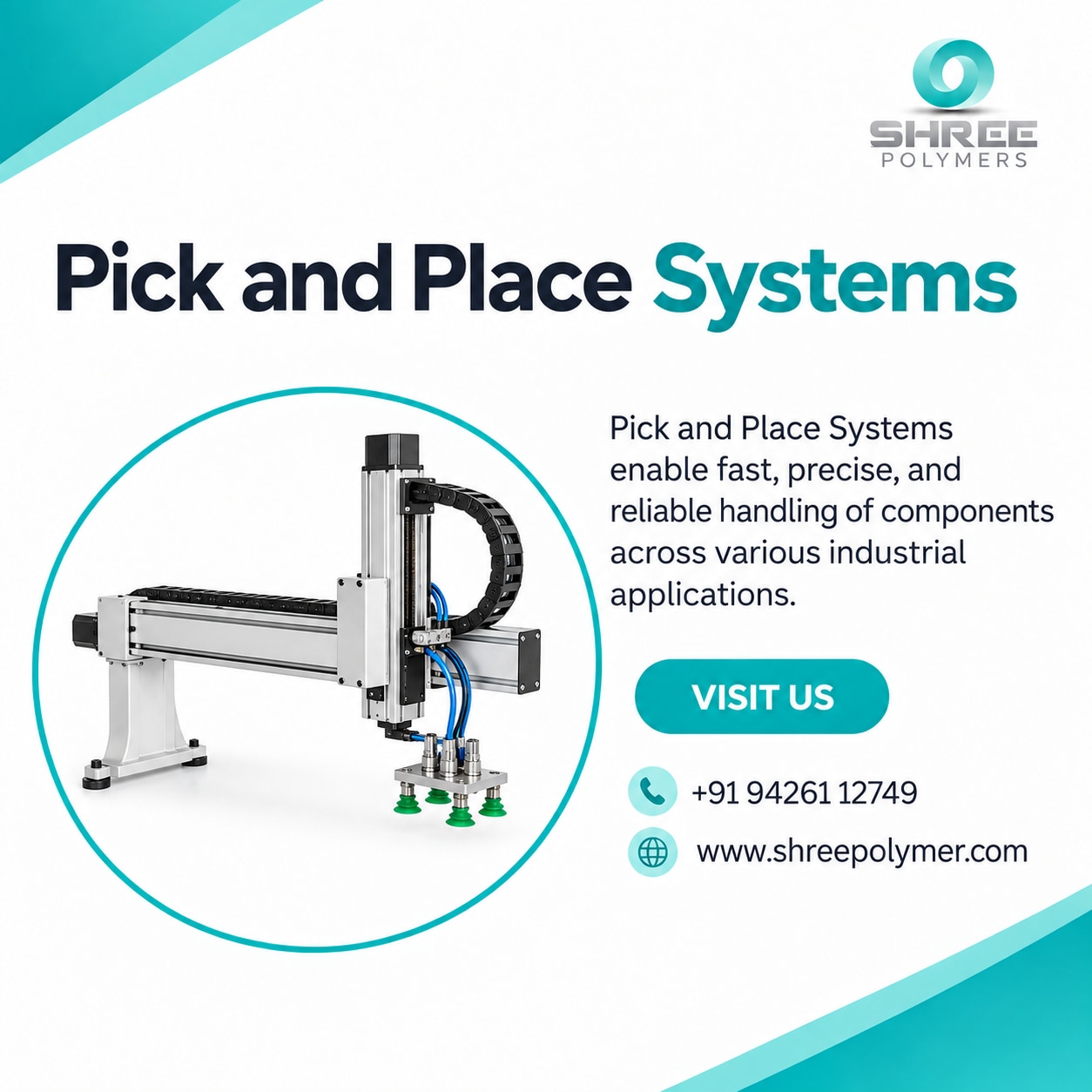 | Conveyors and Automation Pick and Place Systems Shree Polymers designs customised pick-and-place systems as part of its automation offering for packaging-system improvement. |
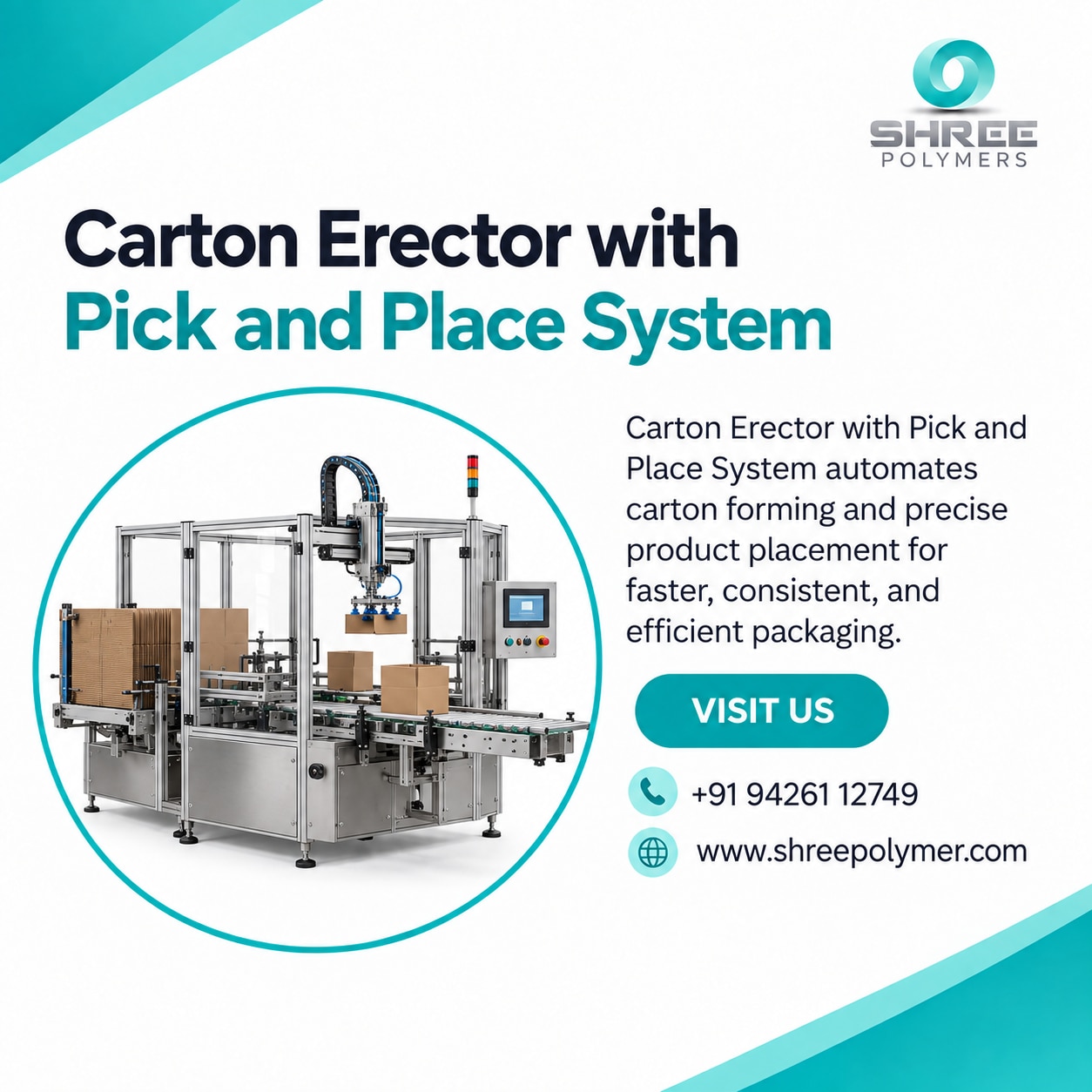 | Conveyors and Automation Carton Erector with Pick and Place System A carton erector with pick-and-place system is presented within Shree Polymers’ customised automation range. |
Frequently asked questions
How should you measure pick-and-place system output?
Measure good parts per minute after detection, gripping, transfer, placement, release, rejects and short stoppages—not the robot’s maximum empty cycle.
Which pick-and-place arrangement fits an Ankleshwar factory?
Choose delta for high-speed lightweight handling, SCARA for compact planar movements, gantry for structured layouts and heavier loads, articulated robots for reach and varied orientations, and pneumatic systems for simple repetitive motions.
What product details must you specify before selecting a gripper?
Provide product dimensions, weight, surface, temperature, fragility, permitted contact points, orientation, spacing, speed and placement accuracy.
What should you compare beyond the robot price?
Compare the complete cell, including conveyors, sensors, vision, tooling, safety guarding, controls, change parts, reject handling, installation, training, maintenance and spare parts.
How can you test a pick-and-place supplier before installation?
Run representative products through a witnessed trial and record good parts per minute, accuracy, reject recovery, changeover time, fault recovery and access for cleaning and maintenance.